Hydrilla Light Requirements and Photosynthesis
Explore how hydrilla's unique low-light requirements allow it to grow deeper and earlier than native aquatic plants, giving it a massive competitive advantage.
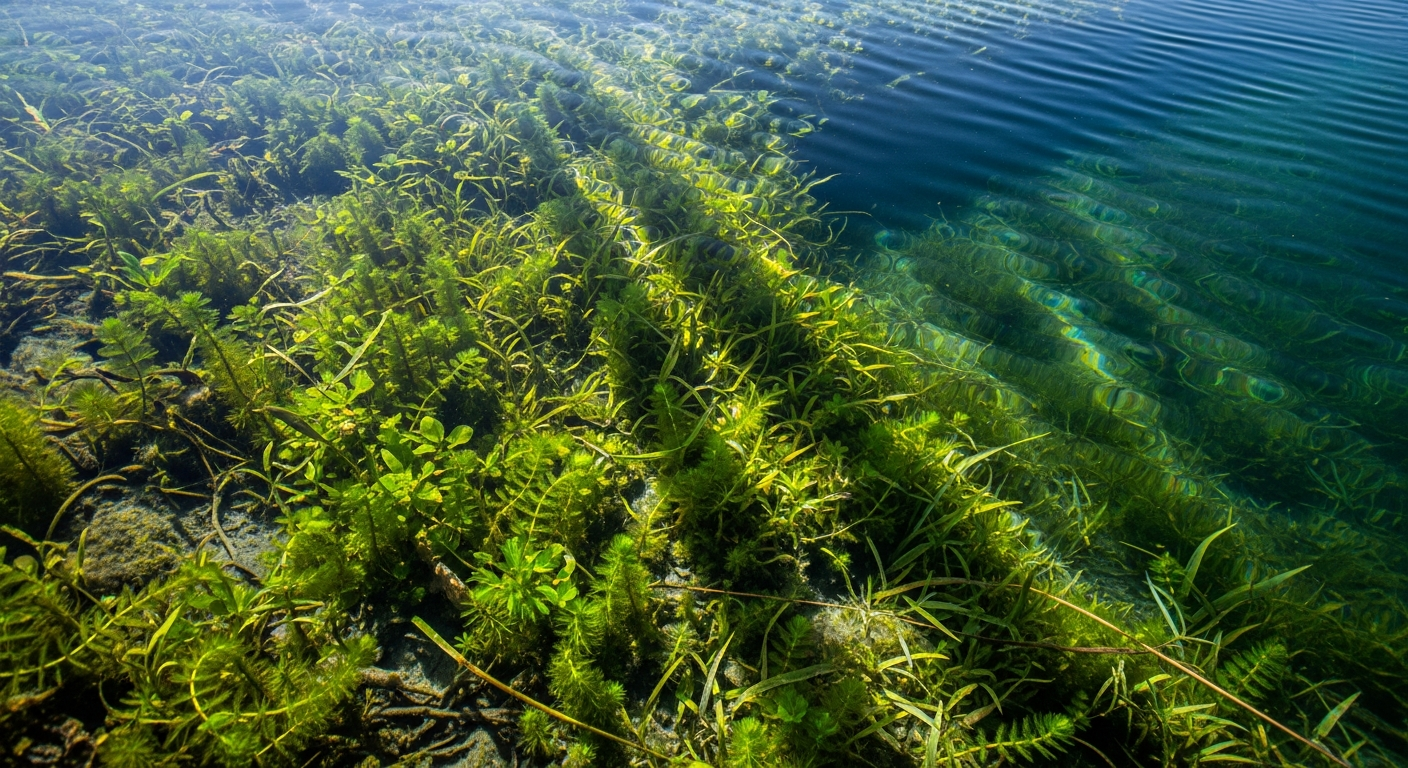
Hydrilla Light Requirements: The 1% Advantage
One of the defining biological characteristics of Hydrilla verticillata is its extraordinary ability to photosynthesize in extremely low-light conditions. While most native aquatic plants require high levels of sunlight to thrive, hydrilla has evolved a significant competitive advantage.
This low-light tolerance is the engine driving its explosive growth and its ability to completely dominate a waterbody from the bottom up.
Photosynthesis in the Dark
Scientific research shows that hydrilla can begin active photosynthesis and growth when receiving as little as 1% of full sunlight.
This physiological trait provides hydrilla with three major ecological advantages over native flora:
- Deeper Growth: Hydrilla can establish roots and begin growing at depths of up to 20 feet (and sometimes deeper in exceptionally clear water), well beyond the photic zone limits of competing native plants.
- Earlier Start: In the spring, when the sun is lower in the sky and days are shorter, hydrilla can wake from dormancy and begin growing weeks before native plants have enough light to break dormancy.
- Longer Days: Hydrilla can begin photosynthesizing earlier in the morning and continue later into the evening than its competitors.
The Canopy Effect
Hydrilla's low-light tolerance is merely the first phase of its attack. It uses this ability to establish a foothold in deep water and quickly shoot stems up toward the surface.
Once the stems reach the upper 1 to 2 feet of the water column, the plant's strategy shifts. It begins branching profusely, creating a dense, tangled mat or "canopy" across the surface.
This canopy acts like a giant solar panel, capturing almost all available sunlight. Because hydrilla blocks up to 95% of the light from penetrating deeper into the water, native plants trapped beneath the canopy are starved of solar energy and quickly die off.
Impact on Management Strategies
Hydrilla's light requirements make certain management strategies difficult. Because it can grow so deep, mechanical harvesting is often ineffective—harvesters can only cut the top few feet of the canopy, leaving the deep-rooted stems entirely untouched and ready to regrow.
Furthermore, in lakes with poor water clarity (high turbidity), native plants may be restricted to the shallowest shorelines, while hydrilla can still colonize the murky depths. This forces lake managers to rely heavily on systemic aquatic herbicides or biological controls (like grass carp) that can reach the deep biomass.
Explore Related Topics
References
Information presented on this page is supported by peer-reviewed research, federal agencies, and state resource management programs.
- U.S. Geological Survey (USGS) – Nonindigenous Aquatic Species Databasehttps://nas.er.usgs.gov
- U.S. Army Corps of Engineers – Aquatic Plant Control Research Programhttps://www.erdc.usace.army.mil
- NOAA Aquatic Invasive Species Programhttps://www.noaa.gov