Monoecious vs. Dioecious Hydrilla
Explore the two distinct biotypes of Hydrilla verticillata in the United States, their reproductive strategies, geographic distribution, and implications for aquatic plant management.
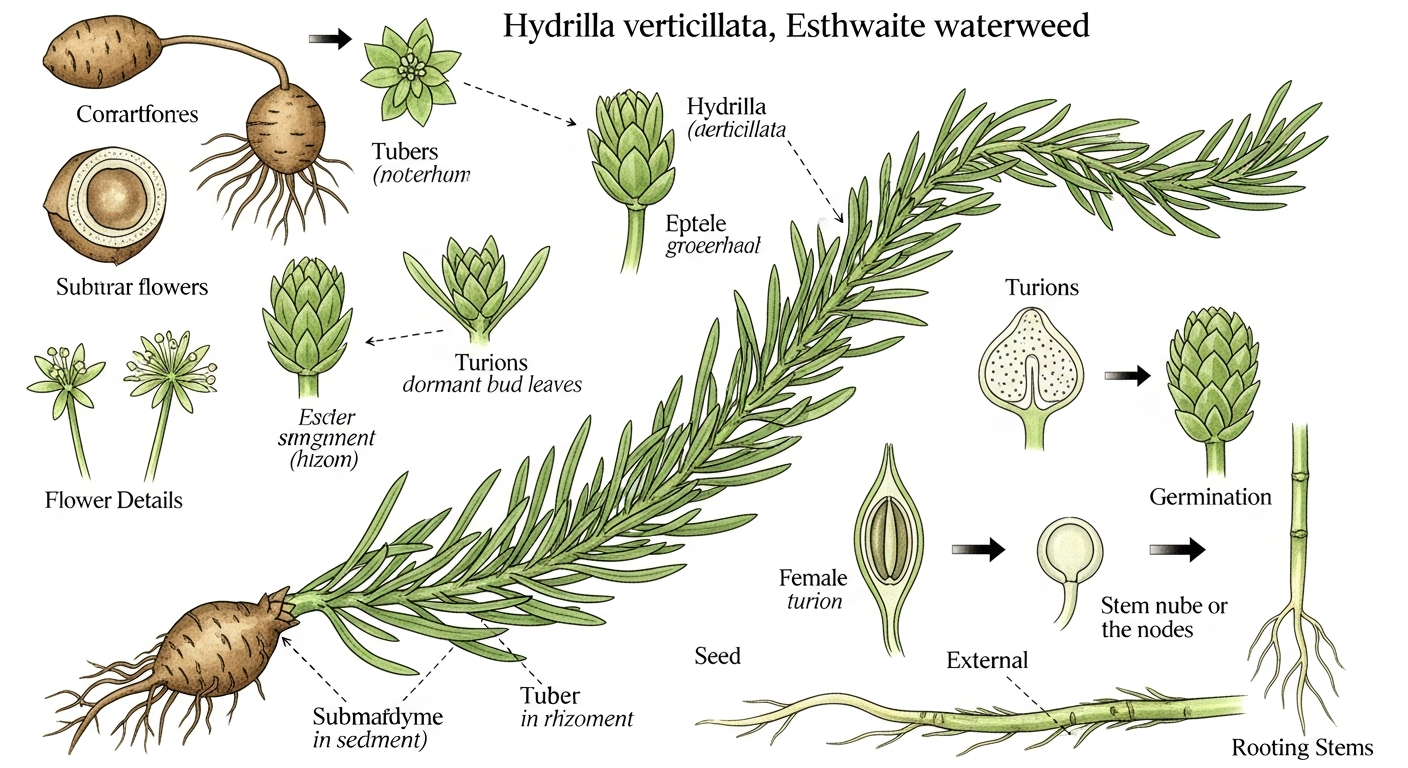
Two Distinct Threats: Monoecious and Dioecious Hydrilla
In the United States, Hydrilla verticillata exists as two distinct biotypes (strains): monoecious and dioecious. While they share the same fundamental physical characteristics—such as whorled, serrated leaves and the ability to form dense surface mats—their life cycles, reproductive strategies, and climate tolerances differ significantly.
Understanding which biotype is present in a specific waterbody is one of the most critical steps in formulating an effective lake management and eradication plan.
Dioecious Hydrilla: The Southern Invader
The dioecious strain was the first to arrive in the United States, discovered in Florida in the 1950s after being imported for the aquarium trade.
- Reproduction: In botany, "dioecious" means male and female flowers grow on separate plants. However, only female dioecious hydrilla plants exist in the U.S. Because there are no males to provide pollen, this strain cannot produce viable seeds. It spreads entirely through vegetative fragmentation, tubers, and turions.
- Growth Habit: It behaves primarily as a perennial. In warm southern climates, it maintains its vegetative biomass year-round, growing continually without a significant winter die-back.
- Tuber Production: It forms robust subterranean tubers slowly over the course of the growing season.
- Distribution: Predominantly found in the Deep South, stretching from Florida across the Gulf Coast to Texas, and into southern California.
Monoecious Hydrilla: The Northern Adapter
The monoecious strain was discovered decades later (around 1980) in the Potomac River Basin near Washington D.C. It is better adapted to temperate climates with distinct, freezing winters.
- Reproduction: "Monoecious" means a single plant produces both male and female flowers. While it is theoretically capable of producing viable seeds, its primary method of explosive spread remains vegetative.
- Growth Habit: It behaves more like an annual plant. It dies back completely to the sediment during freezing winters and rapidly resprouts from tubers in the spring.
- Tuber Production: Because it must survive the winter, it invests enormous energy into early and rapid tuber production. It can begin forming tubers much earlier in its life cycle compared to the dioecious strain.
- Distribution: Found stretching up the Eastern Seaboard from North Carolina to Maine, throughout the Midwest, and into the Pacific Northwest.
Management Implications of the Two Biotypes
The distinction between monoecious and dioecious hydrilla forces lake managers to drastically alter their treatment timelines and herbicide selections.
- Treatment Timing: For monoecious hydrilla, herbicides must be applied early in the spring, shortly after the tubers sprout, to kill the plant before it has a chance to produce a new crop of tubers for the following winter. For dioecious hydrilla, treatment windows are wider due to its perennial growth.
- Herbicide Uptake: Because monoecious hydrilla grows incredibly fast in the early season, it is highly susceptible to systemic herbicides during this rapid growth phase.
- Eradication Difficulty: The aggressive tuber production of the monoecious strain means a lake's sediment can quickly become loaded with thousands of tubers per square meter, requiring multi-year (often 5-10 year) management plans to exhaust the tuber bank.
Explore Related Biology Topics
References
Information presented on this page is supported by peer-reviewed research, federal agencies, and state resource management programs.
- U.S. Geological Survey (USGS) – Nonindigenous Aquatic Species Databasehttps://nas.er.usgs.gov
- U.S. Army Corps of Engineers – Aquatic Plant Control Research Programhttps://www.erdc.usace.army.mil
- NOAA Aquatic Invasive Species Programhttps://www.noaa.gov