Hydrilla vs Milfoil: Key Identification Differences
Learn how to tell the difference between Hydrilla and Eurasian Watermilfoil. Compare leaf structures, growth habits, and visual ID characteristics.
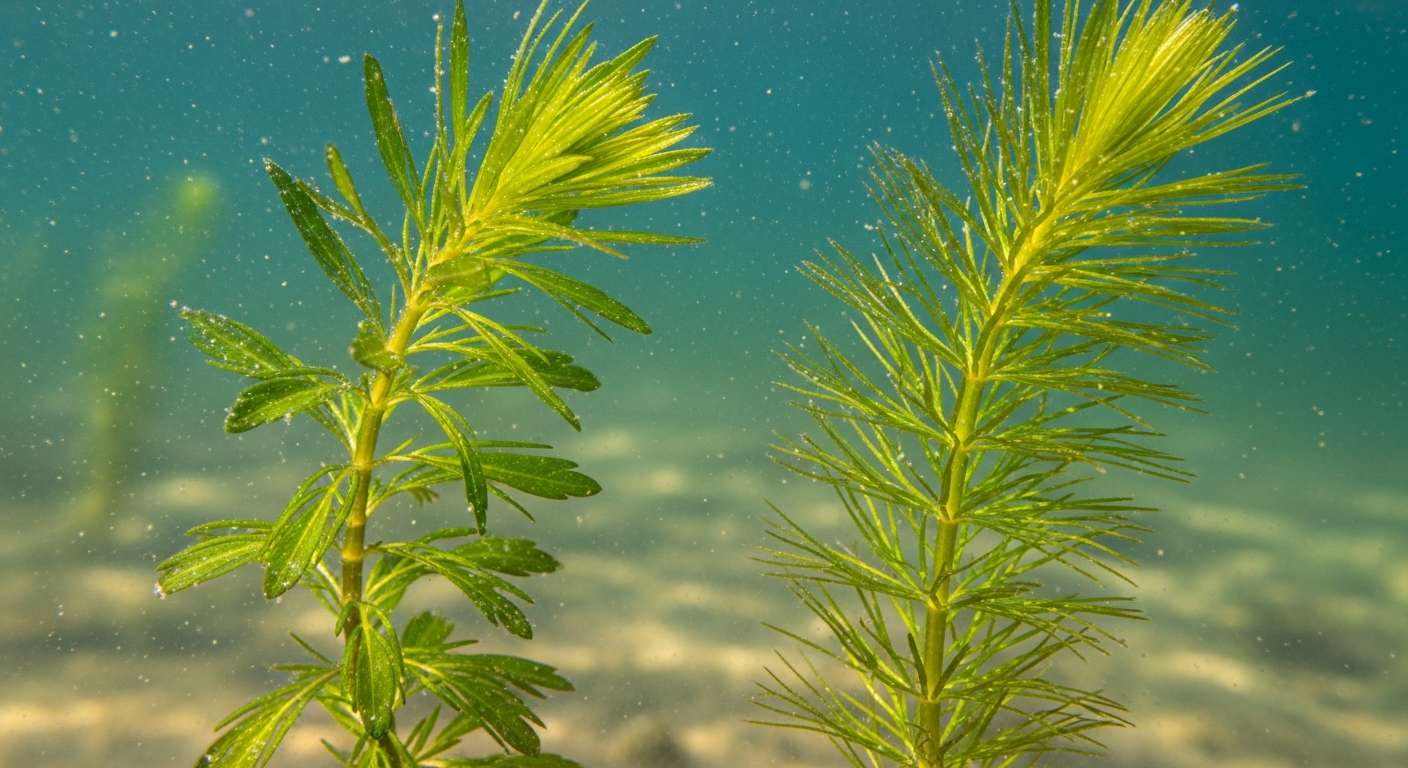
Visual Identification: Hydrilla vs. Milfoil
When determining "what does hydrilla look like" compared to Eurasian watermilfoil (Myriophyllum spicatum), the primary distinction lies in their leaf structures. While both are invasive submerged aquatic plants that form dense mats, a quick visual inspection of a single leaf node is usually enough to tell them apart.
Misidentifying hydrilla as milfoil (or vice versa) can lead to ineffective management strategies, as the chemical and biological control methods for these two distinct species vary significantly.
Leaf Structure Comparison
The most reliable way to differentiate these plants is to examine a single leaf removed from the stem.
Hydrilla Leaves
- Shape: Simple, strap-like or lanceolate (not divided).
- Margins: Noticeably serrated (toothed) edges visible to the naked eye.
- Arrangement: Whorls of 4 to 8 leaves around the stem.
- Midrib: Often has tiny spines or prickles on the underside.
Eurasian Milfoil Leaves
- Shape: Finely divided, feather-like appearance.
- Leaflets: Each leaf consists of a central axis with 12-21 pairs of thread-like leaflets.
- Arrangement: Usually in whorls of 4, sometimes 3 or 5.
- Collapse: Leaves tend to collapse and cling to the stem when removed from water.
Stem and Growth Habit
Both plants are capable of forming incredibly dense, impenetrable mats at the water's surface, shading out native vegetation and impeding recreation.
- Stems: Eurasian milfoil stems are often reddish or brownish and become leafless toward the base. Hydrilla stems are typically green, profusely branched, and retain leaves further down.
- Flowers: Milfoil produces tiny, reddish flowers on emergent spikes that stick out above the water surface. Hydrilla's female flowers are tiny, translucent-to-white, and float on the surface attached by a long thread.
- Root Systems: Only hydrilla produces subterranean tubers (small, potato-like structures). Finding tubers in the sediment is a definitive confirmation of hydrilla.
Why Accurate ID Matters for Management
The presence of tubers in hydrilla completely changes the management approach. While Eurasian watermilfoil can sometimes be managed by targeting the plant biomass and root crowns, hydrilla requires long-term strategies (often spanning 5-10 years) to exhaust the tuber bank hidden in the sediment.
Both plants reproduce rapidly through fragmentation—meaning boat propellers or mechanical harvesters that chop the plants can inadvertently spread them to new areas if fragments aren't carefully contained.
Explore Related ID Guides
References
Information presented on this page is supported by peer-reviewed research, federal agencies, and state resource management programs.
- U.S. Geological Survey (USGS) – Nonindigenous Aquatic Species Databasehttps://nas.er.usgs.gov
- U.S. Army Corps of Engineers – Aquatic Plant Control Research Programhttps://www.erdc.usace.army.mil
- NOAA Aquatic Invasive Species Programhttps://www.noaa.gov