Hydrilla Depth Range: How Deep Can It Grow?
Discover the incredible depth range of hydrilla. Find out how its low-light tolerance allows it to colonize water depths up to 25 feet.
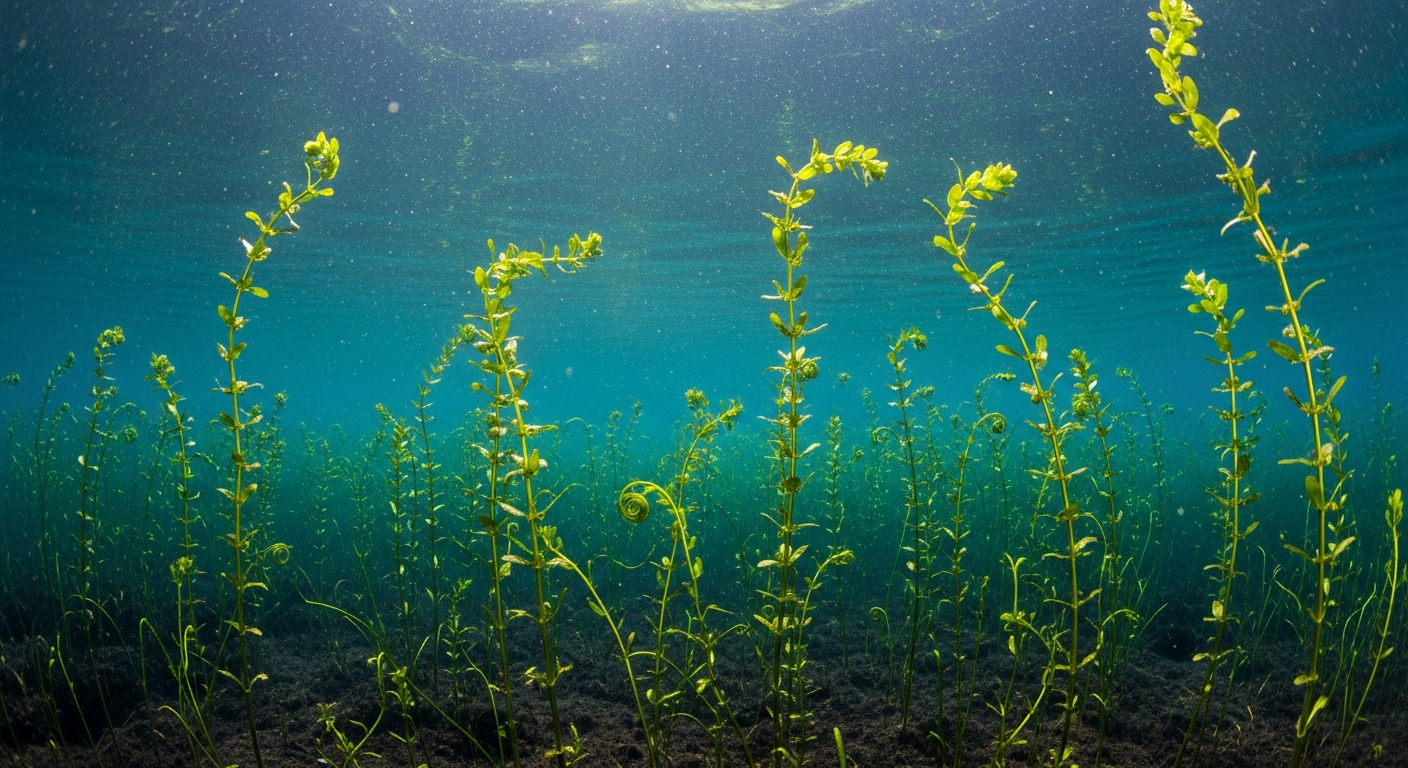
Hydrilla Depth Range: Colonizing the Deeps
When determining the potential impact of an infestation, one of the most pressing questions is: "how deep can hydrilla grow?" For Hydrilla verticillata, the answer is often much deeper than lake managers expect, making it uniquely difficult to control.
While most native submerged aquatic plants are restricted to the shallow littoral zones near the shoreline, hydrilla can colonize the dark, deep bottoms of lakes and reservoirs.
Water Clarity Dictates Depth
Hydrilla's depth range is entirely dependent on water clarity (the "photic zone"). Because hydrilla requires only 1% of full sunlight to photosynthesize, it pushes the boundaries of where plant life can exist in a lake.
- Turbid (Murky) Water: In stained or muddy lakes with poor clarity, hydrilla may be restricted to depths of 3 to 6 feet. However, it will still out-compete native plants that might only survive in 1 to 2 feet of the same water.
- Moderate Clarity: In average lakes and reservoirs, hydrilla commonly thrives in depths of 10 to 15 feet.
- High Clarity (Clear Water): In crystal clear, spring-fed rivers (like Crystal River in Florida) or highly oligotrophic lakes, hydrilla has been documented growing vigorously at depths exceeding 25 feet.
The "Wall of Weed" Effect
Because hydrilla can root in water 20 feet deep and grow stems rapidly to the surface, it creates a massive "wall of weed" that extends from the deep bottom straight up to the top of the lake.
This incredible depth range means that hydrilla doesn't just ring the shoreline like native plants; it can literally fill the entire volume of a cove or bay. A 20-foot column of water entirely choked with hydrilla stems poses severe dangers to boaters and swimmers, who can easily become entangled in the dense, unseen lower branches.
Management Challenges at Depth
Hydrilla's extreme depth range severely complicates eradication efforts:
- Mechanical Harvesting: Harvesters typically only cut down to 5 or 6 feet. If hydrilla is rooted in 15 feet of water, mechanical harvesting only trims the top third of the plant, leaving 10 feet of stem untouched.
- Benthic Barriers: Placing weed mats on the lake bottom is impossible or highly impractical at depths of 20 feet.
- Herbicide Dilution: Treating deep water requires significantly more herbicide to achieve the required concentration (parts per million or ppb) throughout the entire water column, drastically increasing the cost of treatment.
Explore Related Topics
References
Information presented on this page is supported by peer-reviewed research, federal agencies, and state resource management programs.
- U.S. Geological Survey (USGS) – Nonindigenous Aquatic Species Databasehttps://nas.er.usgs.gov
- U.S. Army Corps of Engineers – Aquatic Plant Control Research Programhttps://www.erdc.usace.army.mil
- NOAA Aquatic Invasive Species Programhttps://www.noaa.gov