Hydrilla Biology & Ecology
Scientific overview of the biological traits and life cycle characteristics that contribute to the persistence and spread of Hydrilla verticillata.
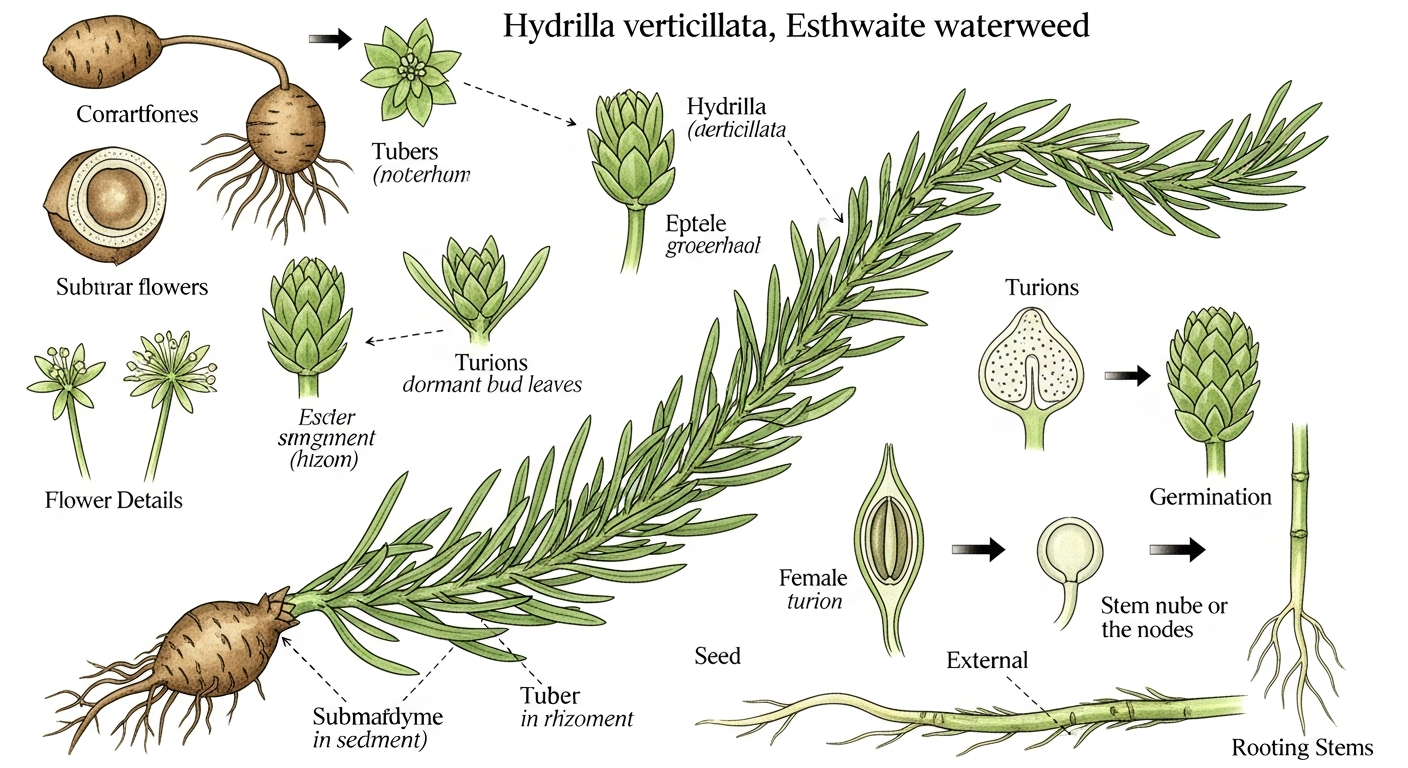
In This Section
Life Cycle
Seasonal growth stages including overwintering, rapid vegetative expansion, flowering, and late-season energy allocation.
Reproduction
Sexual and vegetative reproductive strategies including monoecious and dioecious biotypes.
Tubers
Subterranean perennating structures responsible for long-term sediment persistence.
Turions
Axillary vegetative buds that contribute to short-term dispersal and overwinter survival.
Overview of Biological Characteristics
Hydrilla verticillata exhibits a combination of growth traits that enable rapid colonization and long-term persistence in freshwater systems. These traits include aggressive vegetative expansion, efficient nutrient uptake, and the production of specialized survival structures.
Biological resilience is central to the plant's invasive potential and management difficulty.
A full species overview is available in the Hydrilla master guide.
Dominance of Vegetative Reproduction
Although Hydrilla is capable of sexual reproduction, vegetative propagation is the primary mechanism of expansion in many invaded regions.
Stem fragments, tubers, and turions enable rapid regrowth and localized spread, often making eradication challenging once populations are established.
Detailed reproductive mechanisms are explained in the reproduction section.
Hydrilla Growth Mechanics
Understanding the rapid proliferation and resilient biology of Hydrilla verticillata is critical to managing its spread. Learn more about the specific mechanisms that allow hydrilla to dominate freshwater ecosystems:
Sediment Persistence Mechanisms
Subterranean tubers may remain viable in sediment for multiple growing seasons, allowing populations to rebound even after surface vegetation has been reduced.
Axillary turions further enhance resilience by providing short-term survival structures capable of dispersal.
Seasonal Growth Dynamics
Hydrilla follows a temperature-dependent seasonal cycle that includes overwinter dormancy, spring sprouting, rapid summer expansion, and late-season storage allocation.
Understanding this cycle is essential for timing management interventions.
See the life cycle section for detailed seasonal patterns.
Biological Traits and Ecosystem Impact
The same traits that enhance Hydrilla's survival also contribute to ecological disruption. Rapid canopy formation alters light penetration, habitat structure, and nutrient cycling.
Ecological consequences are described in the ecological & economic impact section.
Implications for Management
Effective management strategies must account for sediment tuber banks, seasonal growth timing, and vegetative fragmentation.
Integrated control approaches are outlined in the Hydrilla control section.
Geographic variation in growth dynamics is documented in the distribution section.
References
Information presented on this page is supported by peer-reviewed research, federal agencies, and state resource management programs.
- U.S. Geological Survey (USGS) – Nonindigenous Aquatic Species Databasehttps://nas.er.usgs.gov
- U.S. Army Corps of Engineers – Aquatic Plant Control Research Programhttps://www.erdc.usace.army.mil