Submerged Aquatic Weed Identification Guide
A comprehensive visual ID guide for submerged aquatic weeds. Learn what hydrilla looks like compared to other common invasive and native water plants.
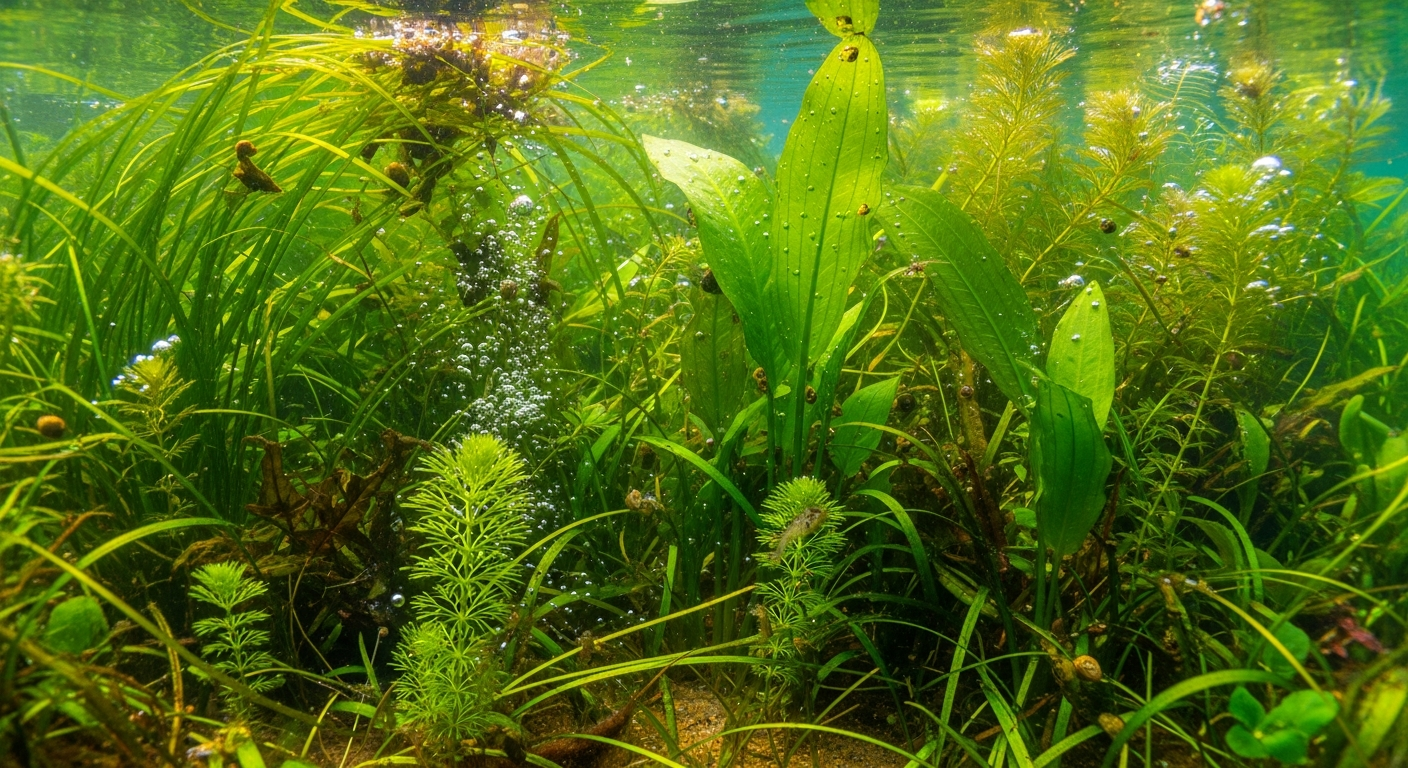
Submerged Aquatic Weed Identification
Submerged aquatic weeds live entirely under the water surface, though they may form dense canopies or produce small flowers that float on top. Knowing exactly "what does hydrilla look like" compared to the broad spectrum of submerged plants is essential for effective lake management.
Misidentifying a native, beneficial plant as an invasive weed can lead to harmful, unnecessary chemical treatments. Conversely, failing to recognize an early infestation of Hydrilla verticillata can allow it to overwhelm an ecosystem.
The "Big Three" Whorled Submerged Plants
The most common identification confusion occurs between three plants that share a similar structural appearance: a central stem with small, strap-like leaves arranged in whorls (circles) around the stem nodes.
Hydrilla (Invasive)
- 4 to 8 leaves per whorl
- Visibly serrated (toothed) margins
- Rough texture
- Produces tubers on roots
Egeria (Invasive)
- 4 to 6 leaves per whorl
- Smooth or very finely serrated margins
- Larger, robust stems and leaves
- No tubers
Elodea (Native)
- Usually 3 leaves per whorl
- Smooth margins
- Softer, smaller leaves
- No tubers
Other Common Submerged Weeds
Beyond the whorled-leaf varieties, several other submerged plants are frequently encountered:
Eurasian Watermilfoil (Invasive)
Instead of simple strap-like leaves, milfoil has finely divided, feather-like leaves usually arranged in whorls of four. Compare Hydrilla vs Milfoil.
Coontail (Native)
A rootless plant with stiff, branching, Y-shaped leaves that bunch heavily at the tips resembling a raccoon's tail. Compare Hydrilla vs Coontail.
Curly-leaf Pondweed (Invasive)
Leaves are arranged alternately (not in whorls) and have a distinctive lasagna-noodle wavy, crinkled edge. Compare Hydrilla vs Pondweed.
Key Steps for Field Identification
- Extract a clean sample: Rinse mud and algae off the stem so you can clearly see the leaf nodes.
- Check the leaf arrangement: Are leaves alternate, opposite, or in a circular whorl?
- Count the whorl: If whorled, count the number of leaves at a single node. 4+ indicates possible Hydrilla or Egeria.
- Inspect the margins: Use a magnifying glass if necessary. Distinct teeth/serrations strongly indicate Hydrilla.
- Check the roots: Gently dig into the sediment. The presence of potato-like tubers is the definitive identifier for Hydrilla.
Deep Dive Comparisons
References
Information presented on this page is supported by peer-reviewed research, federal agencies, and state resource management programs.
- U.S. Geological Survey (USGS) – Nonindigenous Aquatic Species Databasehttps://nas.er.usgs.gov
- U.S. Army Corps of Engineers – Aquatic Plant Control Research Programhttps://www.erdc.usace.army.mil
- NOAA Aquatic Invasive Species Programhttps://www.noaa.gov