Hydrilla Winter Survival: Tubers and Turions
Learn how hydrilla survives freezing winters using subterranean tubers and turions, and why this adaptation makes eradication so difficult in northern climates.
Hydrilla Winter Survival: Outsmarting the Cold
A common misconception among lakefront property owners in northern states is that a harsh, freezing winter will naturally kill off an invasive hydrilla infestation. Unfortunately, Hydrilla verticillata has evolved highly effective mechanisms for winter survival, relying primarily on tubers and turions.
Understanding how hydrilla overwinters is essential for recognizing why single-season herbicide treatments rarely result in full eradication.
The Monoecious Die-Back (Northern Strain)
In northern climates, waterbodies are typically invaded by the monoecious strain of hydrilla. This biotype acts much like an annual plant.
As autumn approaches, daylight shortens, and water temperatures drop, monoecious hydrilla shifts its energy away from vertical stem growth. Instead, it funnels enormous amounts of carbohydrates down into its root system to rapidly produce subterranean tubers.
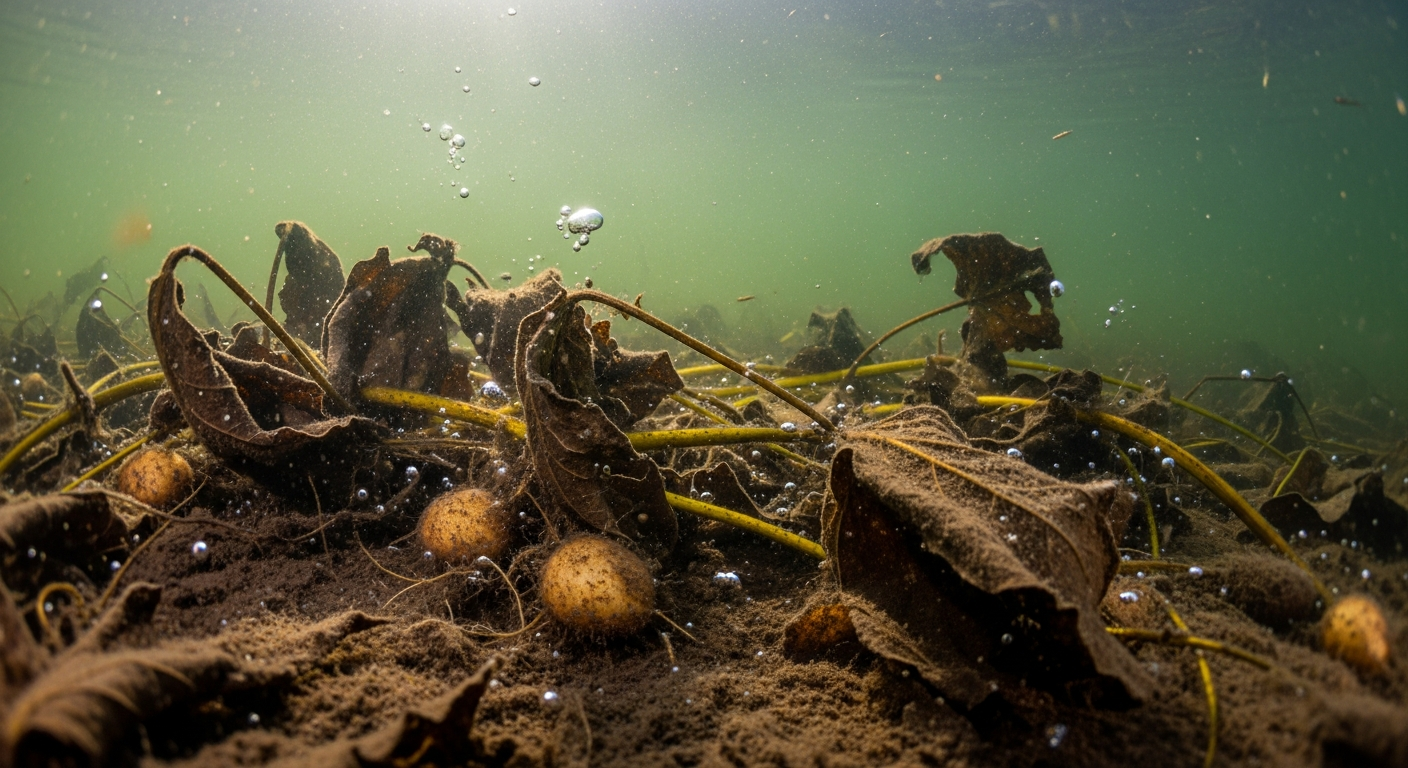
When the water finally freezes, the tall, dense surface mats of hydrilla collapse, rot, and sink to the lake bottom. To the untrained eye, the lake looks clear. But beneath the mud, thousands of newly formed tubers sit insulated from the ice, waiting for spring.
Tubers: The Ultimate Survival Mechanism
Subterranean tubers are hydrilla's primary overwintering strategy. Because they are buried several inches into the benthic sediment, they are protected from freezing temperatures, ice scour, and even winter draw-downs (deliberately lowering the lake water level).
- Longevity: Tubers can remain viable in the cold sediment for 4 to 7 years.
- Staggered Hatching: Not all tubers sprout at once. Some will sprout in the spring, while others remain dormant. If an early spring herbicide kills the first wave, a second dormant wave may sprout weeks later.
- Protection: Because they have no vascular connection to the above-ground plant during dormancy, fall herbicide treatments applied to the water column cannot reach or kill the tubers.
Turions: The Backup Plan
While tubers grow underground, hydrilla also produces turions (compact, dark green winter buds) in the leaf axils along the stems.
As the main plant dies back and decays in the winter, these turions break off and fall to the lake bottom. They lay on the surface of the sediment, acting much like seeds. When the water warms in the spring, the turions open and begin growing into new hydrilla stems.
Turions are more vulnerable to freezing and desiccation than tubers because they are not buried deeply in the mud. However, they are highly mobile and easily carried by winter currents to new areas of the lake.
Explore Related Topics
References
Information presented on this page is supported by peer-reviewed research, federal agencies, and state resource management programs.
- U.S. Geological Survey (USGS) – Nonindigenous Aquatic Species Databasehttps://nas.er.usgs.gov
- U.S. Army Corps of Engineers – Aquatic Plant Control Research Programhttps://www.erdc.usace.army.mil
- NOAA Aquatic Invasive Species Programhttps://www.noaa.gov