Hydrilla vs Coontail: Visual Comparison Guide
Compare Hydrilla verticillata and Coontail (Ceratophyllum demersum). Learn the distinct visual characteristics, leaf structures, and root systems that differentiate them.
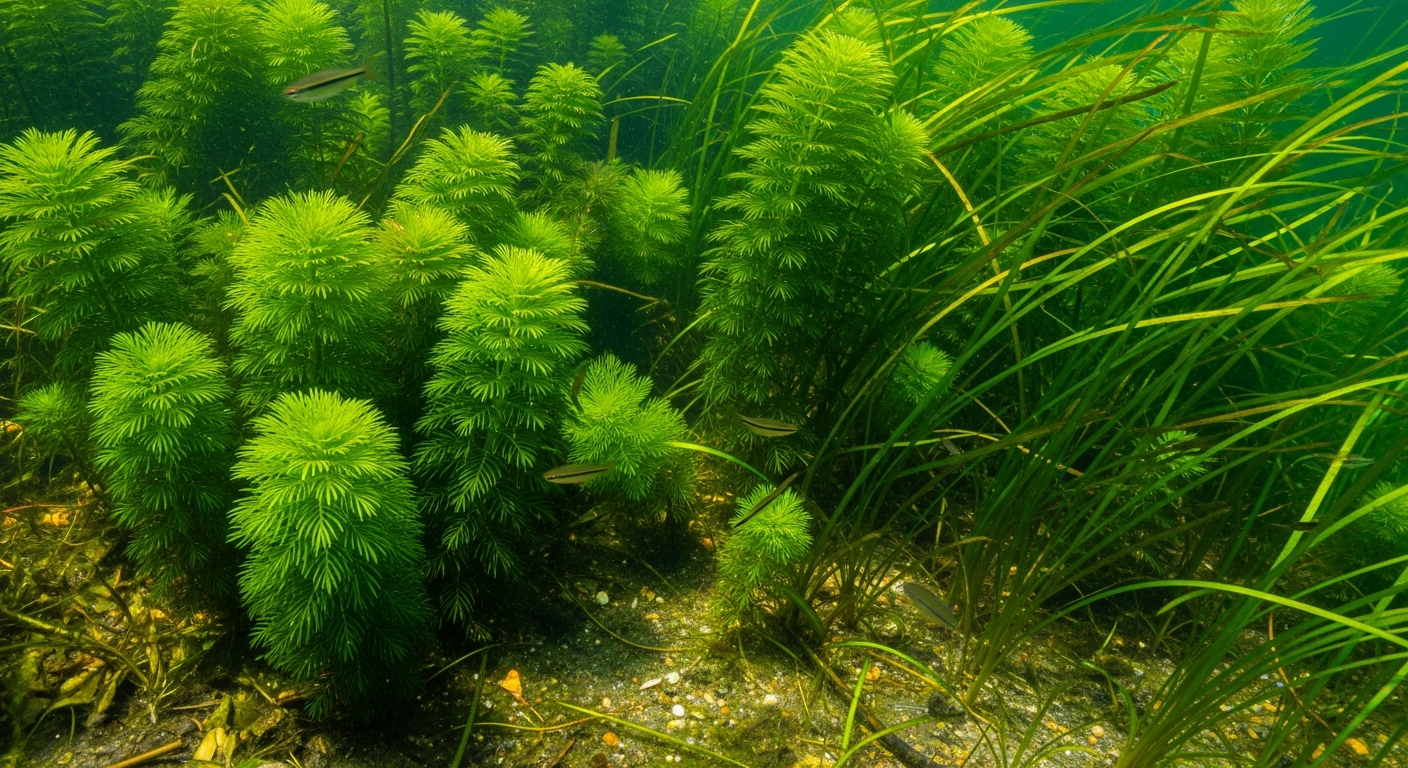
Visual Identification: Hydrilla vs. Coontail
When determining "what does hydrilla look like" in comparison to Coontail (Ceratophyllum demersum), the visual differences are quite pronounced once you know what to look for. While both are submerged aquatic plants that can grow densely, they have entirely different leaf structures, textures, and root systems.
Coontail is a beneficial native plant in North America that provides excellent habitat for fish and aquatic invertebrates. Misidentifying native coontail as invasive hydrilla can lead to the unnecessary destruction of a healthy aquatic ecosystem.
Leaf Structure Comparison
The leaves of these two plants are structurally completely different.
Hydrilla Leaves
- Shape: Simple, undivided strap-like or lance-shaped.
- Margins: Prominent serrations (teeth) along the edges.
- Arrangement: Whorls of 4 to 8 leaves around the stem.
- Texture: Generally flexible but rough to the touch due to serrations.
Coontail Leaves
- Shape: Forked, branching leaves that are stiff and brittle.
- Appearance: Leaves are crowded tightly at the stem tips, resembling a raccoon's tail (hence the name).
- Arrangement: Whorled, but the forking makes them look bushier.
- Teeth: May have tiny teeth on one side of the leaf margin, but the defining feature is the Y-shaped fork.
Roots and Growth Habit
Beyond the leaves, examining the base of the plant provides an immediate and definitive ID.
- Root Systems: Coontail has no true roots. It absorbs all its nutrients directly from the water and floats freely, though its lower stems may become lightly buried in the muck to anchor it. Hydrilla has true roots and produces long white rhizomes and tubers deep in the sediment.
- Out of Water: Coontail feels stiff and bristly, holding its shape well when pulled from the water. Hydrilla is softer and limp when out of the water.
- Wintering: Coontail overwinters by sinking to the bottom and forming dense, dark green buds (turions). Hydrilla overwinters primarily via its subterranean tubers and turions.
Why Accurate ID Matters
Because coontail draws nutrients directly from the water column rather than the sediment, it is highly effective at competing with algae and improving water clarity. Eradicating a healthy stand of coontail by mistaking it for hydrilla can lead to severe algae blooms and degraded water quality.
When inspecting a plant, always pull up the base. If it has no roots at all and the leaves fork like a "Y", it is likely coontail or a similar native species. If it is firmly rooted with serrated, undivided leaves, it may be hydrilla.
Explore Related Topics
References
Information presented on this page is supported by peer-reviewed research, federal agencies, and state resource management programs.
- U.S. Geological Survey (USGS) – Nonindigenous Aquatic Species Databasehttps://nas.er.usgs.gov
- U.S. Army Corps of Engineers – Aquatic Plant Control Research Programhttps://www.erdc.usace.army.mil
- NOAA Aquatic Invasive Species Programhttps://www.noaa.gov