Herbicides for Hydrilla Control
Overview of aquatic herbicides used in the management of Hydrilla verticillata, including systemic vs contact formulations, timing, and environmental considerations.
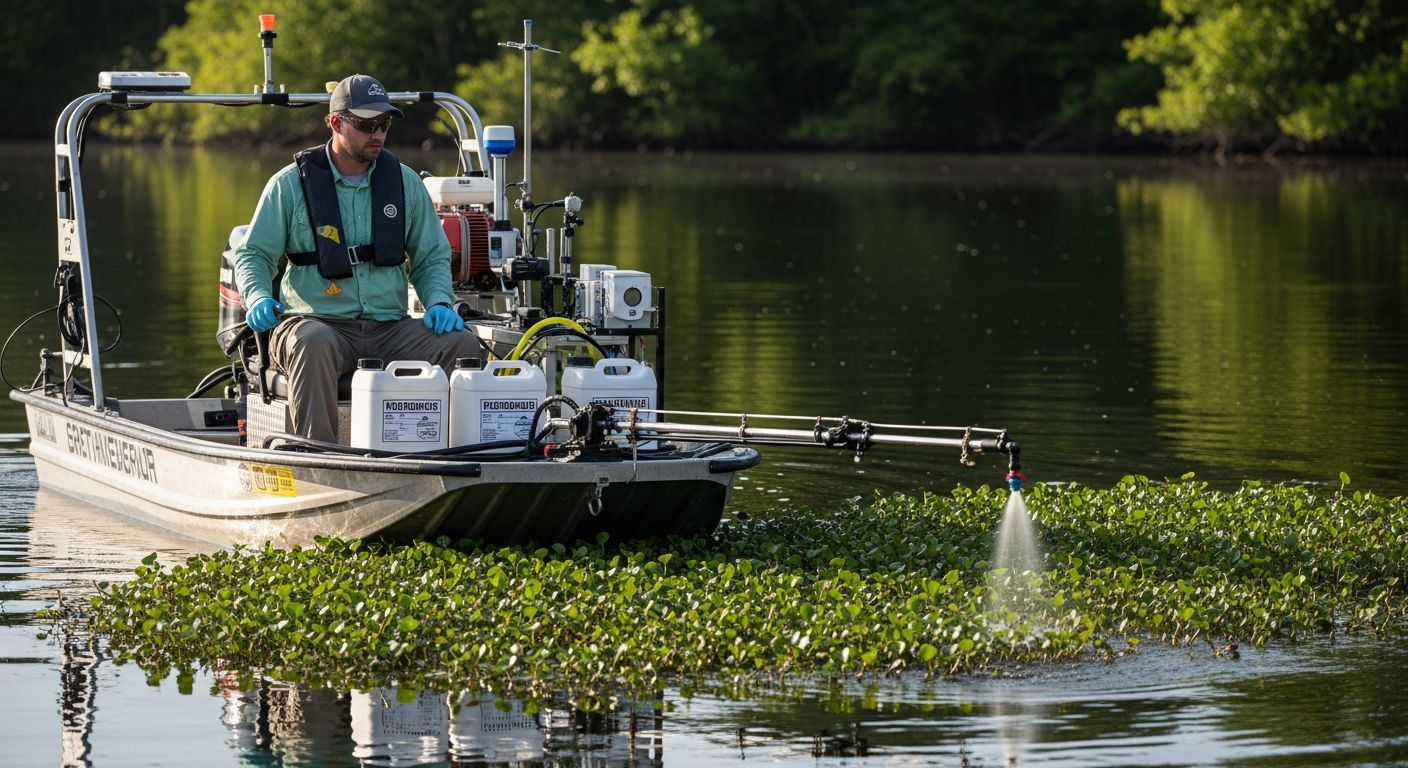
Role of Herbicides in Hydrilla Management
Chemical herbicides are the most widely used and immediate tool for controlling Hydrilla verticillata in freshwater systems. Because hydrilla reproduces aggressively through fragmentation, relying solely on mechanical harvesting is often counterproductive.
However, because hydrilla forms subterranean survival structures (tubers), single herbicide applications rarely result in complete eradication. Instead, herbicide programs are designed to aggressively suppress biomass, restore ecological balance, and gradually exhaust the tuber bank over several years.
Contact vs. Systemic Herbicides
Aquatic herbicides used for hydrilla control fall into two broad categories: contact and systemic. Understanding the difference is crucial for effective lake management.
Contact Herbicides
Contact herbicides act rapidly, destroying the plant tissue they directly touch. They are the aquatic equivalent of a "burn-down" chemical.
- Pros: Immediate visual results (often within days). Excellent for clearing boat lanes, marinas, and swimming areas quickly.
- Cons: They do not travel down into the root system. The underground tubers and deep roots remain perfectly healthy, guaranteeing regrowth.
- Common Actives: Diquat, Endothall (dipotassium salts), Copper formulations.
Systemic Herbicides
Systemic herbicides are absorbed through the leaves or roots and translocate throughout the entire vascular system of the plant.
- Pros: They attack the entire plant, including the root system, providing much longer-term control and helping to prevent new tuber formation.
- Cons: They act slowly (often taking 30 to 90 days to show full mortality). They typically require maintaining a specific concentration in the water (bump treatments) over a long duration.
- Common Actives: Fluridone, Florpyrauxifen-benzyl (ProcellaCOR), Penoxsulam, Imazamox.
Environmental and Regulatory Considerations
The application of aquatic herbicides is heavily regulated by both the EPA and state-level environmental agencies (like the FWC in Florida or the DEC in New York).
- Dissolved Oxygen Depletion: When massive amounts of hydrilla die and rot simultaneously, the decomposition process consumes the oxygen in the water. If a heavily infested lake is treated all at once with a fast-acting contact herbicide, the resulting oxygen crash can cause massive fish kills. Large lakes are usually treated in sections to prevent this.
- Water Use Restrictions: Depending on the active ingredient used, there may be temporary restrictions on using the lake water for drinking, swimming, livestock watering, or irrigation.
- Herbicide Resistance: In parts of Florida, hydrilla has developed genetic resistance to Fluridone after decades of repeated use. Lake managers must now rotate herbicide classes (using Endothall or ProcellaCOR) to prevent resistance.
Integrated Management Strategy
Herbicides are rarely the only tool used. A robust Integrated Pest Management (IPM) plan often involves applying systemic herbicides in the early spring before the hydrilla canopy reaches the surface, followed by stocking triploid grass carp to graze on the weakened regrowth throughout the summer.
References
Information presented on this page is supported by peer-reviewed research, federal agencies, and state resource management programs.
- U.S. Geological Survey (USGS) – Nonindigenous Aquatic Species Databasehttps://nas.er.usgs.gov
- U.S. Army Corps of Engineers – Aquatic Plant Control Research Programhttps://www.erdc.usace.army.mil
- NOAA Aquatic Invasive Species Programhttps://www.noaa.gov