Hydrilla Control & Management
Comprehensive overview of integrated strategies used to manage Hydrilla verticillata infestations, including chemical, biological, mechanical, and long-term planning approaches.
In This Section
How to Kill Hydrilla
Comprehensive guide to hydrilla treatment, herbicides, grass carp, and professional removal strategies.
Hydrilla Removal Services
Guide to professional hydrilla removal contractors, lake management companies, and invasive species control services.
Hydrilla Treatment Cost
Detailed pricing guide covering hydrilla treatment cost per acre, herbicides, grass carp, and professional removal services.
Best Herbicide for Hydrilla
Scientific comparison of fluridone, ProcellaCOR, diquat, and other herbicides used for hydrilla treatment.
Grass Carp Cost
Pricing guide covering triploid grass carp cost per fish, stocking rates per acre, and hydrilla biological control expenses.
Homemade Hydrilla Killer
Scientific evaluation of DIY hydrilla treatments, environmental risks, and safer approved alternatives.
Herbicides
Systemic and contact aquatic herbicides used to suppress Hydrilla biomass.
Grass Carp
Biological control using sterile triploid grass carp.
Mechanical Removal
Harvesting, dredging, and physical biomass reduction techniques.
Lake Management Planning
Strategic long-term integrated pest management programs.
Hydrilla Control and Treatment Strategies
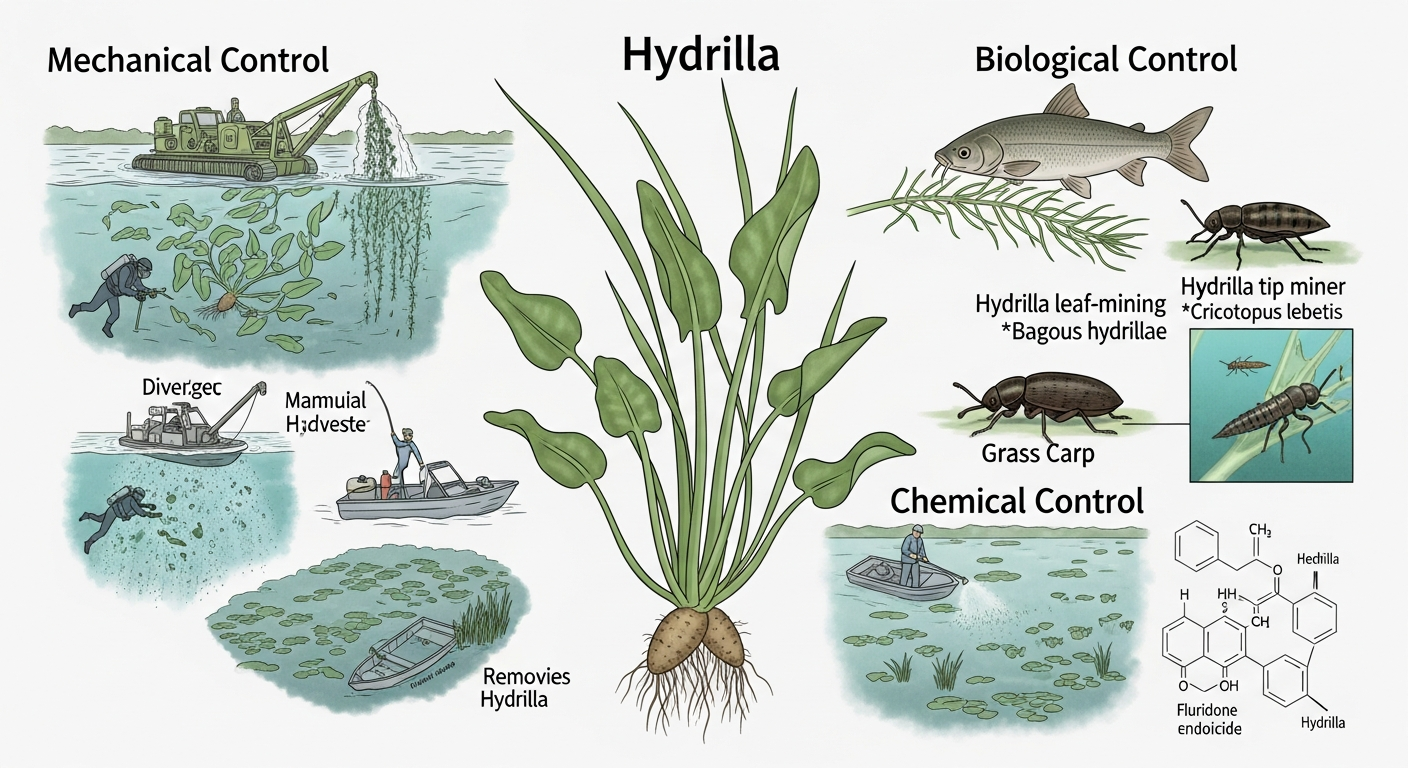
Hydrilla control requires an integrated approach combining chemical, biological, and mechanical strategies. Because Hydrilla verticillata reproduces through tubers, turions, and stem fragmentation, long-term management is typically required.
Effective hydrilla treatment programs focus on reducing canopy density, preventing spread, and limiting sediment tuber banks.
How to Get Rid of Hydrilla
Many property owners ask how to get rid of hydrilla in ponds, lakes, or reservoirs. Complete eradication is rare once hydrilla becomes established. Instead, management programs aim for suppression and control.
The most effective hydrilla removal strategies depend on waterbody size, infestation density, and regulatory constraints.
- Chemical herbicide treatment for systemic suppression
- Triploid grass carp stocking for biological control
- Mechanical harvesting for localized removal
- Integrated lake management planning
Hydrilla Removal vs. Hydrilla Treatment
Hydrilla removal typically refers to mechanical harvesting or physical extraction of vegetation. While removal can improve access and navigation, it often spreads fragments and does not eliminate tubers in sediment.
Hydrilla treatment usually refers to chemical herbicide applications or biological controls that reduce plant density over time.
Most invasive species control programs use a combination of both removal and treatment methods.
Invasive Species Control Programs
Hydrilla invasive species control is managed at both state and federal levels. Programs are designed to protect fisheries, maintain navigability, and preserve ecological balance.
Agencies such as the U.S. Army Corps of Engineers and state wildlife departments implement structured hydrilla management plans tailored to regional conditions.
References
Information presented on this page is supported by peer-reviewed research, federal agencies, and state resource management programs.
- U.S. Geological Survey (USGS) – Nonindigenous Aquatic Species Databasehttps://nas.er.usgs.gov
- U.S. Army Corps of Engineers – Aquatic Plant Control Research Programhttps://www.erdc.usace.army.mil