Hydrilla Treatment Duration and Timelines
Understand the reality of hydrilla treatment duration. Discover why eradicating hydrilla takes multiple years and how lake managers plan long-term control strategies.
The Reality of Hydrilla Treatment Duration
When property owners or lake associations decide to tackle a hydrilla infestation, the most common mistake is expecting a quick fix. Because of the plant’s unique biology, a single herbicide treatment or mechanical harvesting event will never solve the problem permanently.
Understanding the necessary treatment duration and timelines is critical for setting realistic budgets, managing community expectations, and ultimately achieving long-term control.
The Multi-Year Battle: Exhausting the Tuber Bank
The primary reason hydrilla treatment takes so long is the subterranean tuber bank. A single heavily infested acre can contain millions of dormant tubers buried in the sediment.
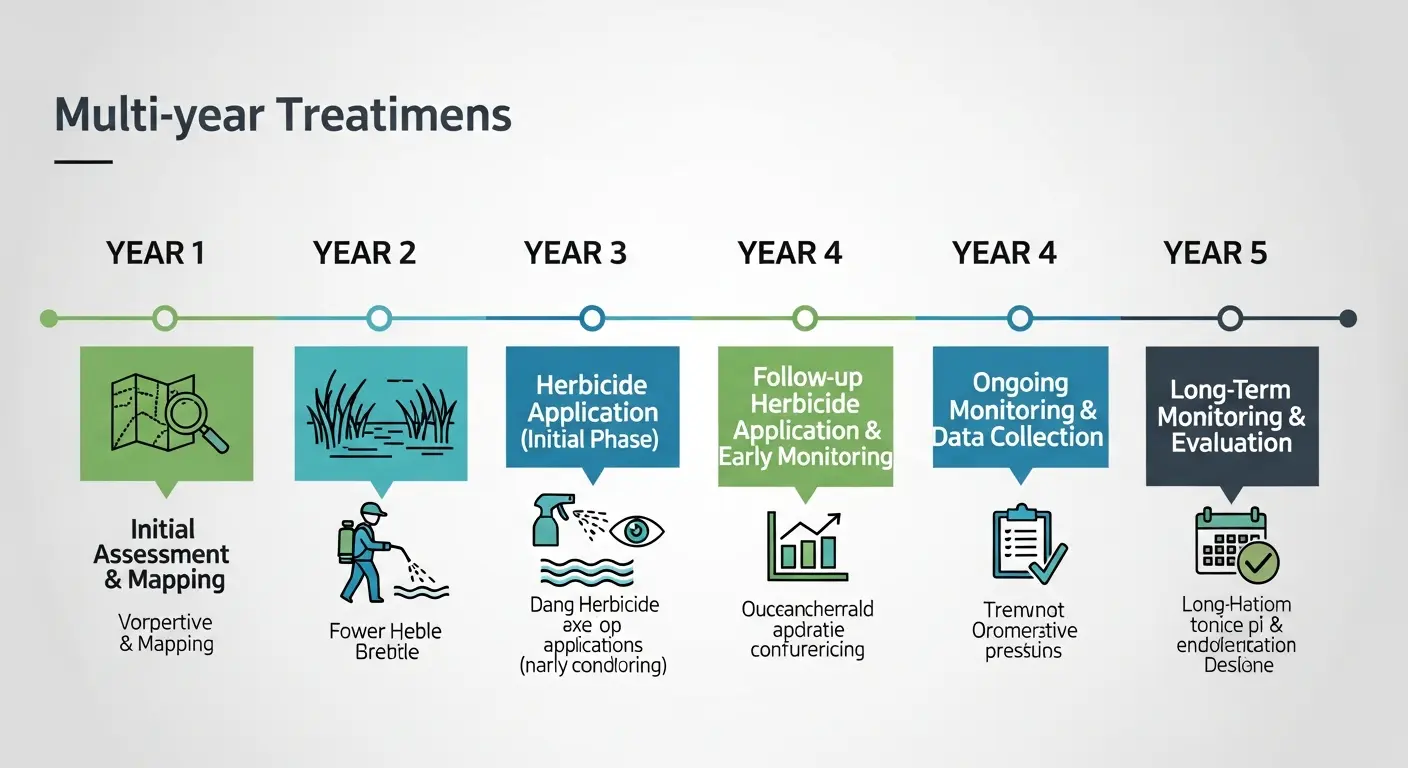
- Year 1: An aggressive systemic herbicide treatment kills 100% of the visible, above-ground hydrilla. The lake looks clean. However, the dormant tubers in the mud are completely unaffected by the chemical.
- Year 2: In the spring, thousands of those dormant tubers sprout. If left untreated, they will quickly reach the surface, form a canopy, and drop a massive new batch of tubers, completely resetting the clock.
- Years 3-7: The lake must be monitored and treated every single year to kill the new sprouts before they have a chance to produce new tubers.
Eradication is only possible once the tuber bank has been completely exhausted, which research shows takes a minimum of 4 to 7 years of zero tuber production.
Herbicide Timelines: Contact vs Systemic
Even within a single growing season, the duration of an herbicide treatment varies drastically depending on the chemical used:
Contact Herbicides (e.g., Diquat, Endothall)
These act like a chemical lawnmower. Within 3 to 7 days of application, the hydrilla turns brown and drops out of the water column. However, the roots remain alive, and the plant will often begin regrowing within 4 to 6 weeks.
Systemic Herbicides (e.g., Fluridone)
These attack the entire plant, including the roots, but work very slowly. It often takes 30 to 90 days of maintaining a specific concentration in the water for the plant to fully die. During this time, the hydrilla will slowly turn pink or white (bleaching) before finally collapsing.
Seasonal Timing is Critical
For monoecious hydrilla (common in northern climates), treatment timing is a narrow window. The optimal time for a systemic treatment is in the early spring, just as the tubers are sprouting but before the plant has developed a massive amount of biomass.
Treating too early means some tubers haven't sprouted yet and will miss the herbicide. Treating too late in the summer means there is a massive amount of plant material that will rot, potentially causing a fish-killing oxygen crash, and the plant may have already dropped new tubers for the following year.
Explore Related Topics
References
Information presented on this page is supported by peer-reviewed research, federal agencies, and state resource management programs.
- U.S. Geological Survey (USGS) – Nonindigenous Aquatic Species Databasehttps://nas.er.usgs.gov
- U.S. Army Corps of Engineers – Aquatic Plant Control Research Programhttps://www.erdc.usace.army.mil
- NOAA Aquatic Invasive Species Programhttps://www.noaa.gov