Hydrilla Identification
Comprehensive field identification guide for Hydrilla verticillata, including leaf morphology, root structures, and comparison with similar aquatic species.
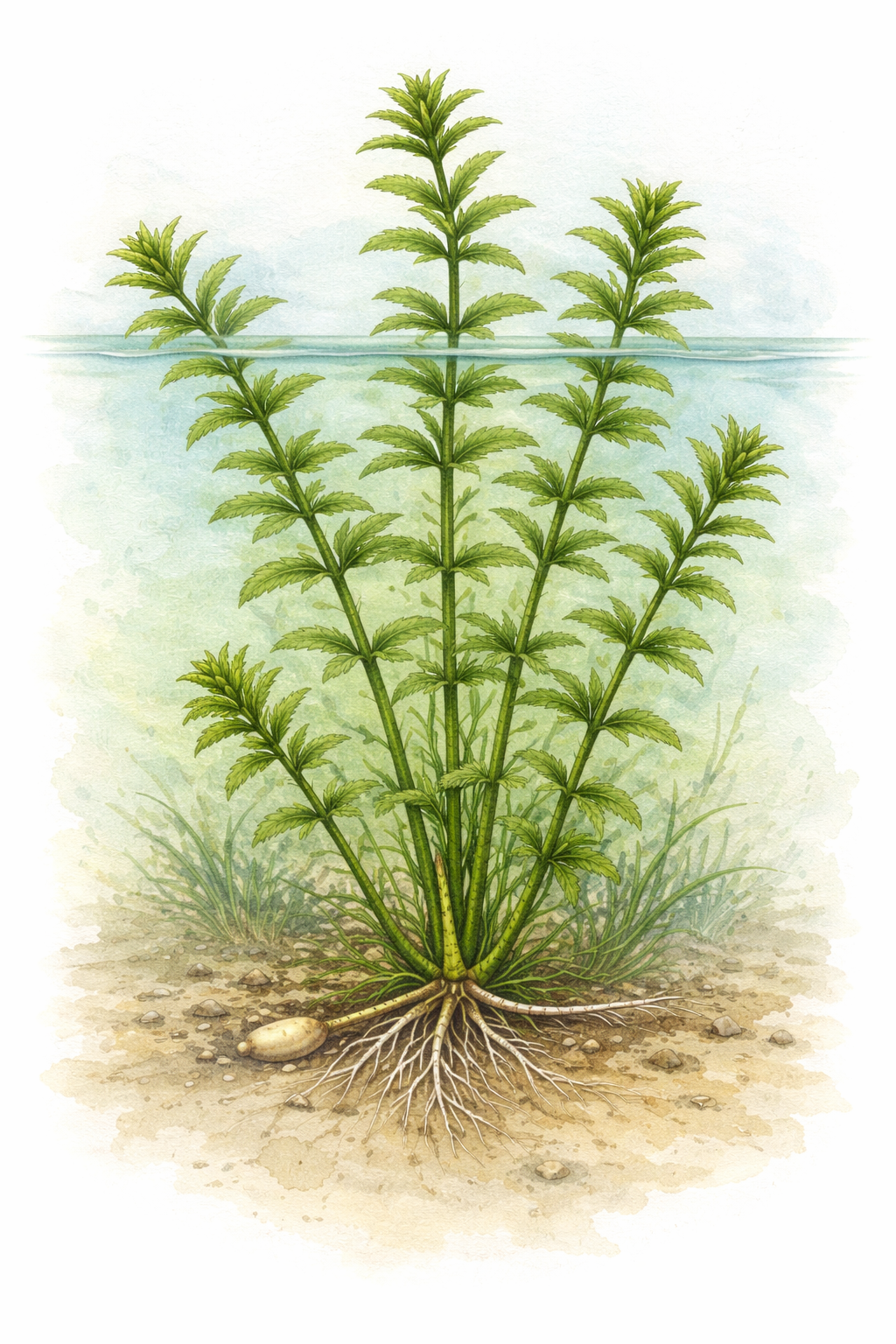
In This Section
Leaf Structure
Whorl arrangement, serrated margins, and midrib characteristics used for field identification.
Root System
Subterranean rhizomes and tubers that distinguish Hydrilla from similar species.
Hydrilla vs. Elodea
Comparison with native Elodea canadensis.
Hydrilla vs. Egeria
Distinguishing Hydrilla from Brazilian Elodea (Egeria densa).
Importance of Accurate Identification
Accurate identification of Hydrilla verticillata is essential for regulatory reporting, ecological monitoring, and management planning. Misidentification may lead to unnecessary treatment of native vegetation or delayed response to invasive spread.
Hydrilla is frequently confused with Elodea canadensis and Egeria densa due to similar submerged growth form.
A full biological overview of the species is available in the Hydrilla master guide.
Primary Diagnostic Characteristics
Hydrilla exhibits several diagnostic features that distinguish it from similar aquatic plants:
- 4–8 leaves per whorl
- Serrated (toothed) leaf margins
- Narrow linear leaves
- Subterranean tubers attached to rhizomes
Detailed leaf traits are explained in the leaf structure section.
Confirming Identification Through Root Structures
Excavation of sediment may reveal potato-like tubers attached to underground rhizomes. The presence of tubers confirms Hydrilla and differentiates it from Elodea and Egeria.
Root and rhizome characteristics are described in the root system section.
Comparison with Similar Species
Proper differentiation between Hydrilla and visually similar species prevents misclassification.
Side-by-side comparisons are available in:
Identification in Geographic Context
In regions where Hydrilla is known to occur, rapid confirmation is critical for management response.
Current distribution patterns are documented in the Hydrilla distribution section.
Management implications of confirmed identification are described in the Hydrilla control section.
References
Information presented on this page is supported by peer-reviewed research, federal agencies, and state resource management programs.
- U.S. Geological Survey (USGS) – Nonindigenous Aquatic Species Databasehttps://nas.er.usgs.gov
- U.S. Army Corps of Engineers – Aquatic Plant Control Research Programhttps://www.erdc.usace.army.mil