Impact of Hydrilla on Fish Populations
Scientific overview of how Hydrilla verticillata influences fish community structure, predator-prey dynamics, habitat complexity, and long-term fisheries outcomes.
Overview of Fisheries Interactions
Hydrilla verticillata significantly alters aquatic habitat structure, which in turn influences fish community composition, recruitment success, and predator-prey dynamics.
The relationship between Hydrilla and fisheries is complex and highly debated. While moderate vegetation provides beneficial nursery habitat and concentrates sportfish, excessive plant density negatively affects ecological balance and overall fish health.
Predator–Prey Dynamics and Stunting
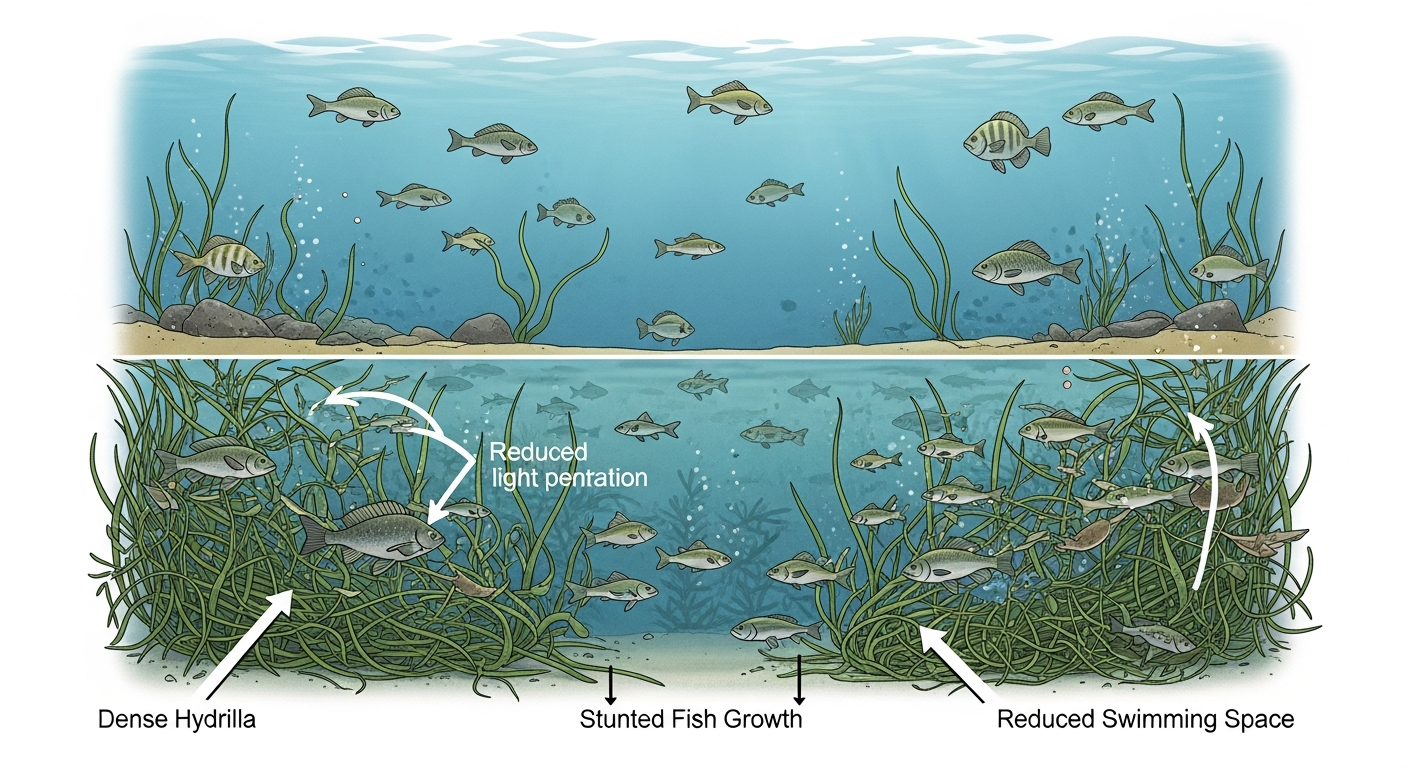
Dense Hydrilla beds drastically alter the interaction between predatory fish (like largemouth bass) and forage fish (like bluegill and shad).
- Overpopulation of Baitfish: Extremely dense weed mats provide too much cover for small forage fish. Predators cannot efficiently penetrate the mats to hunt them.
- Stunted Growth: Because forage fish are overprotected, they overpopulate. The increased competition for limited food resources leads to "stunting," where the lake is filled with thousands of very small, undernourished fish.
- Predator Decline: Unable to feed efficiently on the stunted baitfish hiding in the dense weeds, the larger predatory fish also suffer from poor body condition and declining populations.
Dissolved Oxygen and Fish Kills
One of the most dangerous impacts of hydrilla on fish populations relates to dissolved oxygen dynamics.
During the day, photosynthesis in Hydrilla beds increases dissolved oxygen. However, nighttime respiration by the massive biomass causes oxygen levels to plummet. In shallow, heavily infested lakes, these daily swings can stress fish to the point of lethargy.
More severely, when a large volume of hydrilla dies rapidly—either from a cold snap or an aggressive herbicide application—the bacteria that break down the rotting plant matter consume massive amounts of oxygen. This biological oxygen demand (BOD) can strip the water column of oxygen within days, resulting in catastrophic fish kills.
Management Implications
Fisheries managers face a delicate balancing act. Eradicating all vegetation harms the fishery, but allowing hydrilla to grow unchecked leads to stunted populations and anoxic events.
The goal of a well-designed lake management plan is typically to maintain intermediate vegetation coverage (often targeting 20-30% of the littoral zone) to maximize habitat complexity while preserving open-water access and predator foraging efficiency.
References
Information presented on this page is supported by peer-reviewed research, federal agencies, and state resource management programs.
- U.S. Geological Survey (USGS) – Nonindigenous Aquatic Species Databasehttps://nas.er.usgs.gov
- U.S. Army Corps of Engineers – Aquatic Plant Control Research Programhttps://www.erdc.usace.army.mil
- NOAA Aquatic Invasive Species Programhttps://www.noaa.gov