Lake Management Strategies for Hydrilla
Strategic planning approaches for long-term Hydrilla verticillata management, including integrated pest management (IPM), monitoring, budgeting, and regulatory coordination.
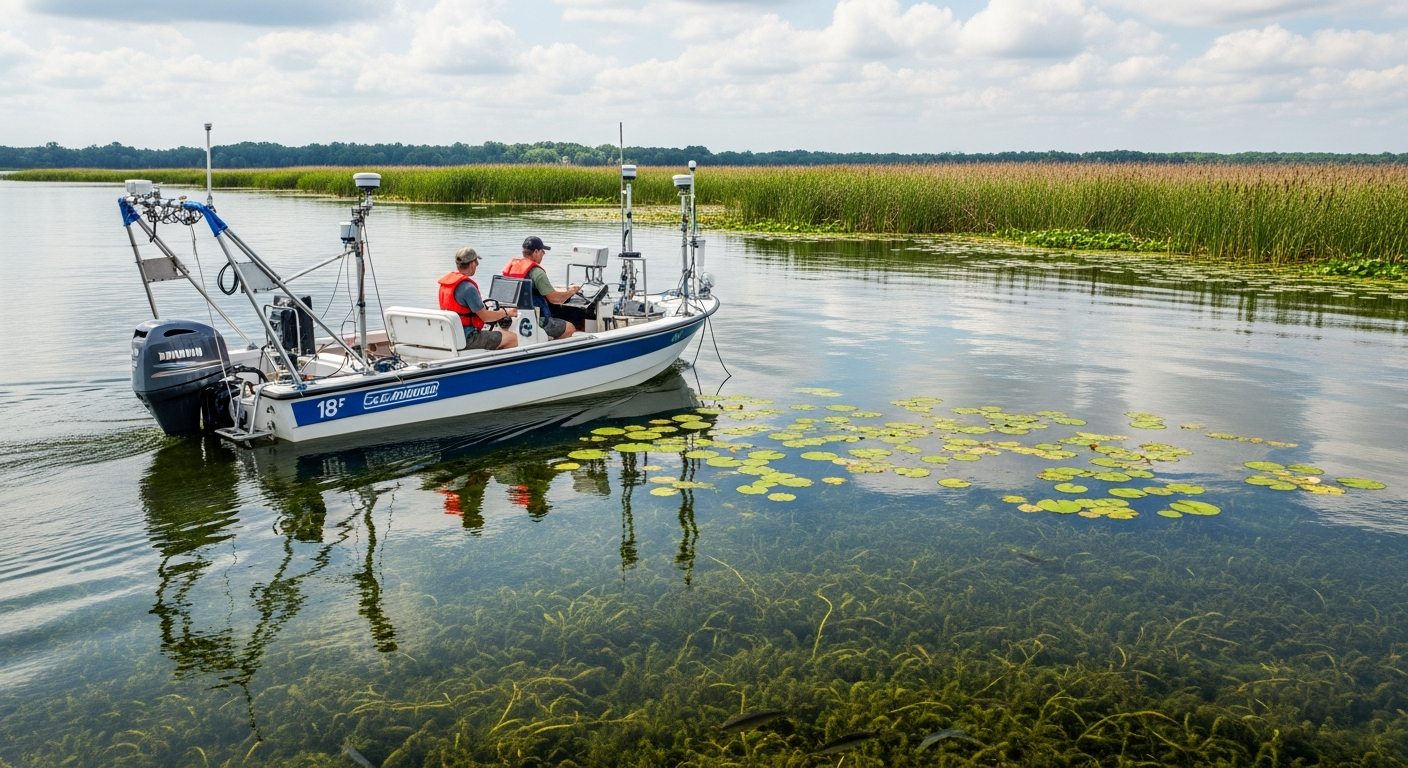
Strategic Overview
Effective Hydrilla verticillata management requires long-term planning rather than isolated, reactive treatment events. Lake management programs are typically designed to suppress vegetation growth while maintaining ecological balance, water quality, and recreational access.
Because hydrilla reproduces through fragmentation, turions, and sediment tubers, complete eradication is rarely feasible on large waterbodies. Instead, professional management focuses on containment, biomass control, and prevention of secondary spread.
Integrated Pest Management (IPM)
Integrated Pest Management (IPM) is the gold standard for aquatic weed control. It combines chemical, biological, and mechanical control methods to achieve sustainable suppression of hydrilla populations, rather than relying exclusively on one approach.
- Phase 1 (Assessment): Mapping the exact acreage of the infestation and determining the biotype (monoecious vs dioecious).
- Phase 2 (Knockdown): Using systemic herbicides or targeted mechanical harvesting to reduce the massive standing biomass.
- Phase 3 (Maintenance): Stocking triploid grass carp or applying low-dose spot treatments to graze on new sprouts before they reach the surface.
Monitoring and Assessment
Ongoing monitoring is critical to adaptive management. Professional lake managers do not guess; they use data to drive decisions. Surveys often include:
- Sonar Mapping: Specialized boats map the lake bottom to calculate the exact volume of hydrilla biomass in the water column.
- Tuber Sampling: Biologists take sediment core samples to count the number of tubers per square meter, which helps predict how severe the regrowth will be next spring.
- Water Quality Testing: Monitoring dissolved oxygen, pH, and nutrient levels before, during, and after herbicide applications to prevent fish kills.
Regulatory Compliance and Budgeting
Successful lake management requires navigating complex regulatory frameworks. Applying restricted-use aquatic herbicides or stocking non-native fish requires permits from state environmental agencies (such as the DNR, DEC, or FWC).
Furthermore, HOAs, municipalities, and lake associations must secure long-term funding. Hydrilla control is an ongoing maintenance expense—often requiring a multi-year budget—not a one-time fix. For an overview of expected expenses, see our guide on hydrilla treatment costs.
Professional Hydrilla Removal Services
Dealing with a severe hydrilla infestation? DK Aquatic provides commercial-grade mechanical harvesting, pond removal, and comprehensive lake management services across the United States, specializing in California and high-priority zones.
Contact DK Aquatic for a ConsultationReferences
Information presented on this page is supported by peer-reviewed research, federal agencies, and state resource management programs.
- U.S. Geological Survey (USGS) – Nonindigenous Aquatic Species Databasehttps://nas.er.usgs.gov
- U.S. Army Corps of Engineers – Aquatic Plant Control Research Programhttps://www.erdc.usace.army.mil
- NOAA Aquatic Invasive Species Programhttps://www.noaa.gov