Lake Removal of Hydrilla: Large Scale Harvesting
Understand the challenges, logistics, and costs of large-scale mechanical hydrilla harvesting on public lakes and reservoirs.
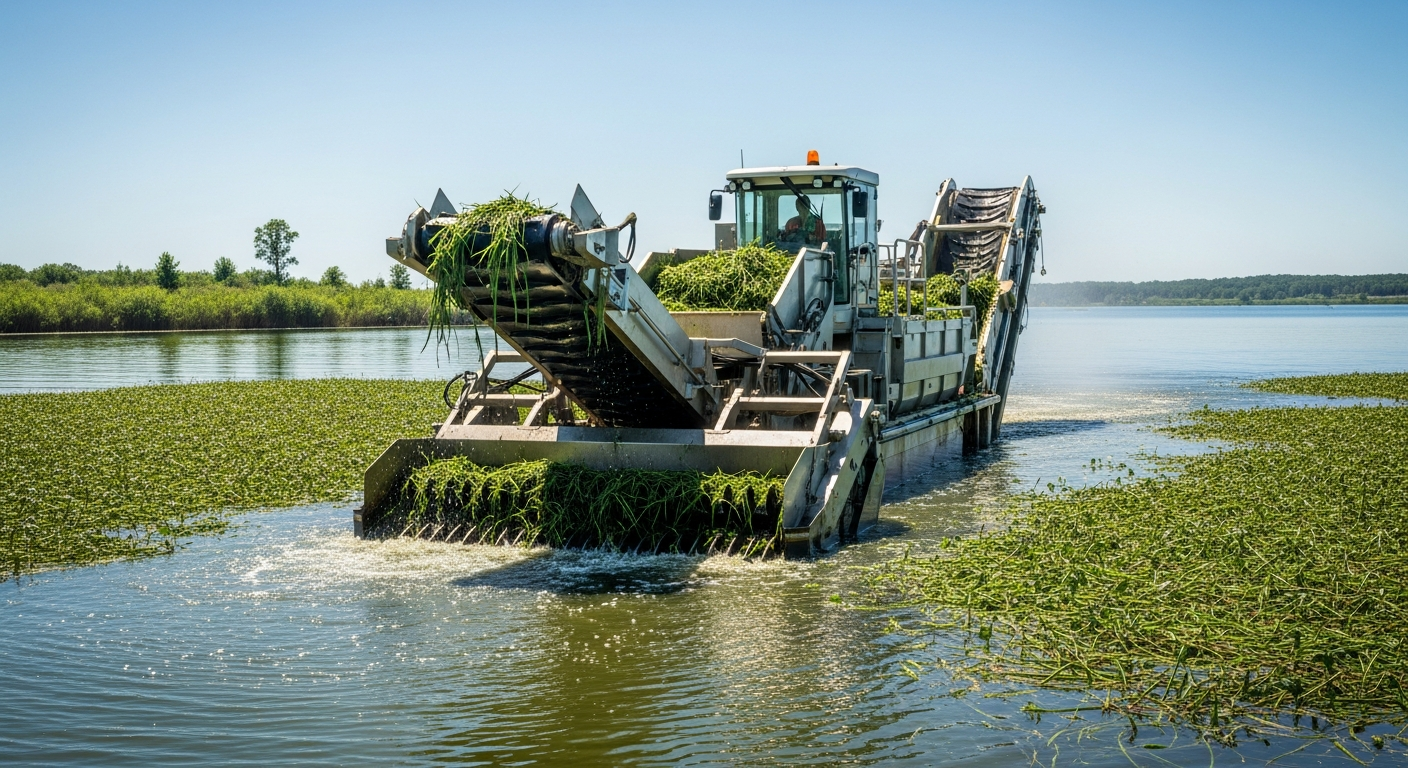
Large-Scale Mechanical Harvesting
When dealing with thousands of acres of Hydrilla verticillata on major public reservoirs, mechanical removal takes on an industrial scale. This is not about eradication; it is about maintaining critical access and infrastructure.
State agencies often deploy fleets of aquatic weed harvesters to keep boat ramps open, clear paths to marinas, and prevent massive weed mats from clogging hydroelectric dam intakes.
The Logistics of Lake Harvesting
Large aquatic harvesters function like floating combine tractors. They use a front-mounted sickle-bar cutter that lowers into the water, cutting the hydrilla stems several feet below the surface.
- The Cutting Process: As the boat moves forward, the cut weeds are pushed onto a porous conveyor belt that carries them out of the water and into a holding bay on the vessel.
- The Weight Problem: Hydrilla is up to 95% water. A dense acre of hydrilla can weigh over 100 tons. The harvester fills up quickly and must frequently travel back to shore to offload.
- The Disposal: The massive pile of wet, rotting vegetation must be loaded onto dump trucks and hauled away from the watershed to prevent fragments from washing back into the lake.
Environmental Protections During Harvesting
Because mechanical cutting generates millions of viable hydrilla fragments, strict environmental protocols must be followed.
Harvesting crews must often deploy floating containment booms (similar to those used in oil spills) around the work area to capture drifting stems. If the operation is near a pristine area of the lake, harvesting might be forbidden entirely due to the high risk of spreading the infestation.
Explore Related Topics
Professional Hydrilla Removal Services
Dealing with a severe hydrilla infestation? DK Aquatic provides commercial-grade mechanical harvesting, pond removal, and comprehensive lake management services across the United States, specializing in California and high-priority zones.
Contact DK Aquatic for a ConsultationReferences
Information presented on this page is supported by peer-reviewed research, federal agencies, and state resource management programs.
- U.S. Geological Survey (USGS) – Nonindigenous Aquatic Species Databasehttps://nas.er.usgs.gov
- U.S. Army Corps of Engineers – Aquatic Plant Control Research Programhttps://www.erdc.usace.army.mil
- NOAA Aquatic Invasive Species Programhttps://www.noaa.gov