Hydrilla vs. Egeria (Brazilian Elodea)
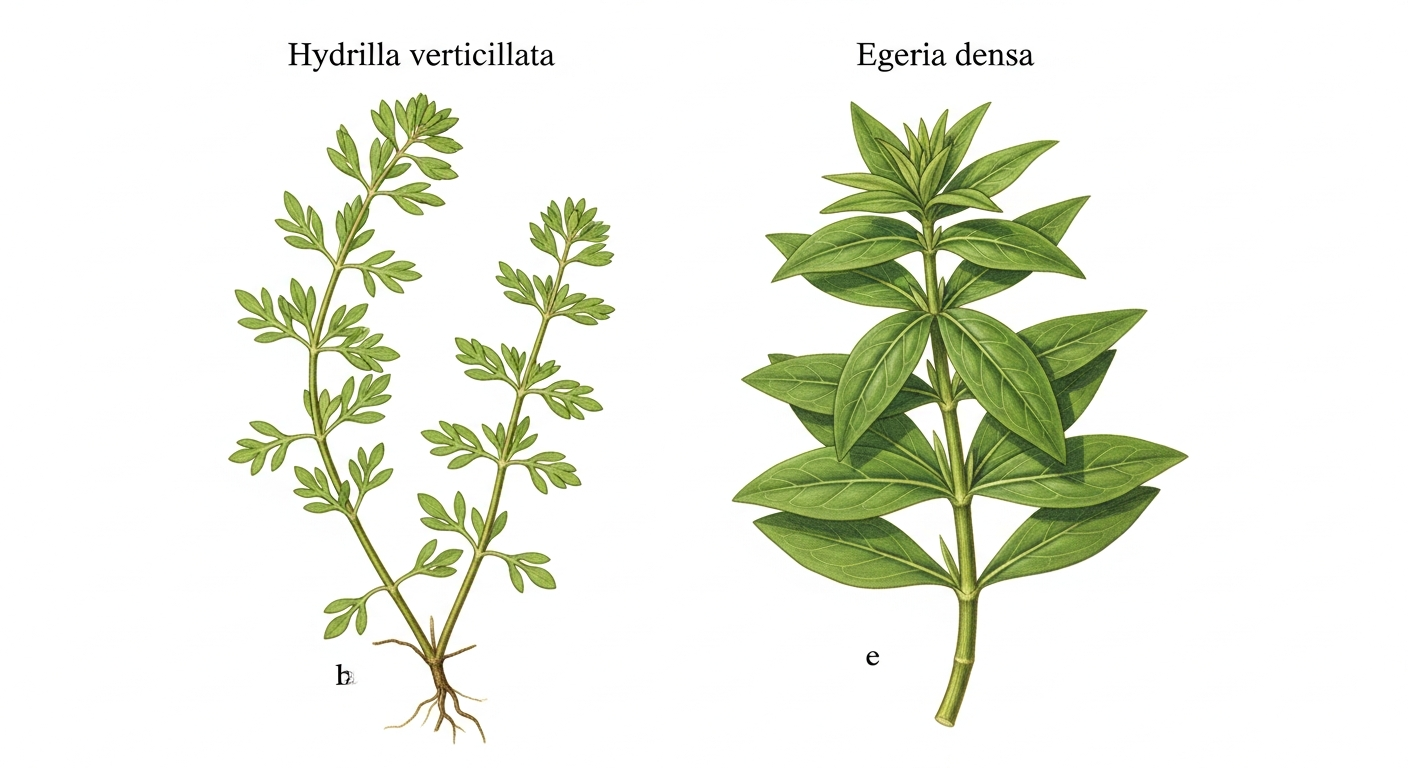
Field comparison guide distinguishing Hydrilla verticillata from Egeria densa based on leaf arrangement, serration, root structures, and growth characteristics.
Why Accurate Differentiation Matters
Hydrilla verticillata and Egeria densa (commonly known as Brazilian Elodea) are both submerged aquatic plants that form dense growth in freshwater systems. Because of visual similarity, misidentification can occur during field surveys.
Correct identification is critical for management planning and regulatory reporting.
A full species overview is available in the Hydrilla master guide.
Leaf Whorl Count
Hydrilla typically has 4 to 8 leaves per whorl around each node.
Egeria densa commonly exhibits 4 to 6 leaves per whorl. While there is overlap, Hydrilla often displays higher leaf counts.
Leaf arrangement is described in detail in the leaf structure section.
Serrated Margins
Hydrilla leaves have clearly visible serrations (small teeth) along the margins. Running a finger along the leaf edge often reveals a rough texture.
Egeria leaves generally lack pronounced serrations and feel smoother to the touch.
Leaf Width and Texture
Hydrilla leaves are typically narrower and more delicate in appearance.
Egeria leaves are often broader, thicker, and more robust.
Subterranean Structures
One of the most reliable distinguishing features is the presence of subterranean tubers in Hydrilla.
Egeria densa does not produce tubers. Excavation of sediment and identification of tuber structures confirms Hydrilla presence.
Detailed tuber morphology is described in the Hydrilla tubers section.
Growth Density and Canopy Formation
Both species can form dense growth, but Hydrilla often produces thicker surface canopies under favorable conditions.
Egeria typically remains slightly more flexible and may not form as persistent sediment tuber banks.
Field Inspection Recommendations
For reliable identification, examine leaf serrations under magnification and inspect below sediment for tubers.
Additional comparisons are available in the Hydrilla vs. Elodea guide.
Distribution patterns where both species may occur are documented in the Hydrilla distribution section.
References
Information presented on this page is supported by peer-reviewed research, federal agencies, and state resource management programs.
- U.S. Geological Survey (USGS) – Nonindigenous Aquatic Species Databasehttps://nas.er.usgs.gov
- U.S. Army Corps of Engineers – Aquatic Plant Control Research Programhttps://www.erdc.usace.army.mil
- NOAA Aquatic Invasive Species Programhttps://www.noaa.gov