Herbicides for Hydrilla Control
Overview of aquatic herbicides used in the management of Hydrilla verticillata, including systemic and contact formulations, regulatory considerations, and integrated treatment strategies.
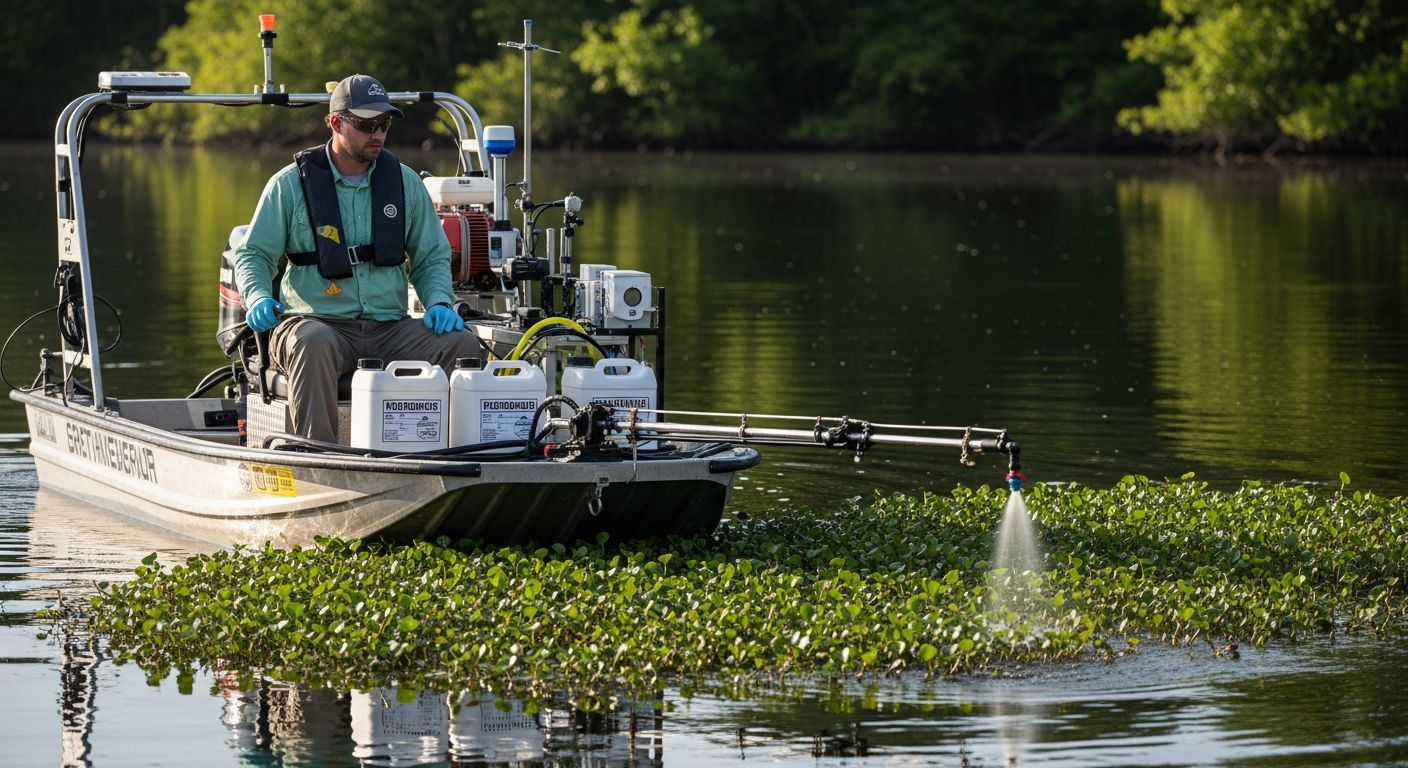
Role of Herbicides in Hydrilla Management
Chemical herbicides are among the most widely used tools for controlling Hydrilla verticillata in freshwater systems. Because Hydrilla reproduces aggressively through fragmentation, tubers, and turions, complete eradication is rarely feasible. Instead, herbicide programs are typically designed to suppress biomass and maintain ecological balance.
Herbicides are generally applied as part of an integrated pest management (IPM) strategy rather than as a standalone solution.
For a complete overview of hydrilla treatment strategies, see our guide on how to kill hydrilla.
Contact vs. Systemic Herbicides
Aquatic herbicides used for Hydrilla control fall into two broad categories: contact herbicides and systemic herbicides.
Contact Herbicides
Contact herbicides act quickly on plant tissues they directly touch. These formulations are often used for rapid biomass knockdown in heavily infested areas. However, contact products typically do not affect subterranean tubers, allowing regrowth to occur.
Systemic Herbicides
Systemic herbicides are absorbed and translocated throughout the plant, including root structures. When properly applied, systemic treatments may reduce tuber production and suppress regrowth.
Hydrilla’s reproductive resilience through sediment tubers is discussed in the Hydrilla tuber biology section.
Common Active Ingredients
Several EPA-registered aquatic herbicides are used in Hydrilla management programs. Common active ingredients may include:
- Fluridone
- Imazamox
- Diquat
- Endothall
- Penoxsulam
Selection depends on waterbody characteristics, infestation severity, regulatory requirements, and management objectives.
All herbicide applications must comply with federal and state pesticide regulations.
Herbicide Resistance Concerns
In some regions, Hydrilla populations have developed resistance to specific herbicide classes following repeated applications. Herbicide rotation and integrated strategies are often recommended to reduce resistance risk.
Resistance development reinforces the importance of combining chemical treatment with biological and mechanical approaches.
Environmental and Regulatory Considerations
Aquatic herbicide use is subject to strict regulatory oversight. Treatment timing, water use restrictions, and environmental impact assessments may be required prior to application.
Management programs must consider potential effects on non-target vegetation, fish habitat, and water quality.
Broader ecological implications are discussed in the Hydrilla impact section.
Integrated Management Strategy
Long-term Hydrilla control typically requires an integrated management strategy combining chemical treatment, biological control, and mechanical intervention.
Biological options such as triploid grass carp and mechanical harvesting methods are often used in conjunction with herbicide applications.
Strategic planning is addressed in the lake management section.
References
Information presented on this page is supported by peer-reviewed research, federal agencies, and state resource management programs.
- U.S. Geological Survey (USGS) – Nonindigenous Aquatic Species Databasehttps://nas.er.usgs.gov
- U.S. Army Corps of Engineers – Aquatic Plant Control Research Programhttps://www.erdc.usace.army.mil
- NOAA Aquatic Invasive Species Programhttps://www.noaa.gov