Hydrilla Tubers
Comprehensive overview of subterranean tubers in Hydrilla verticillata, including formation, sediment longevity, density, and their role in long-term persistence.
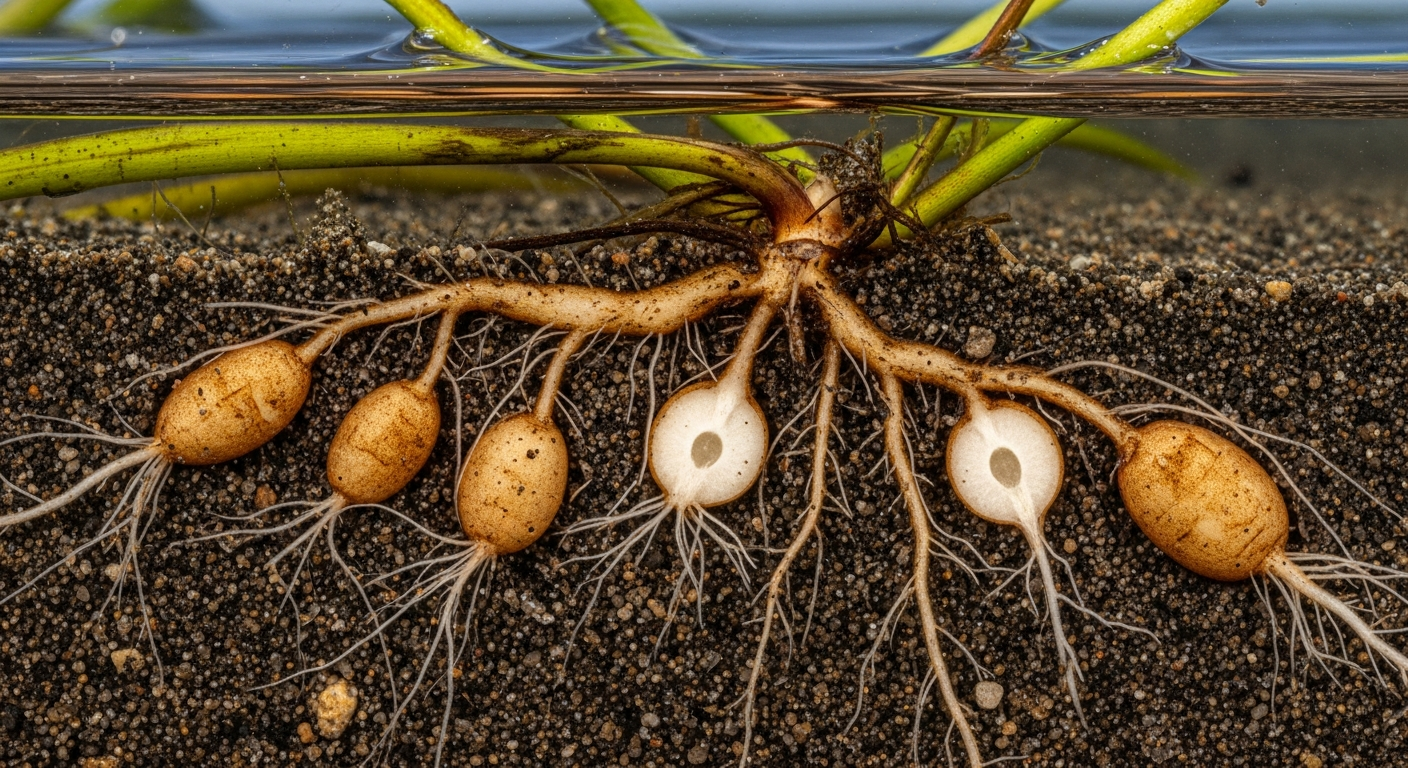
What Are Hydrilla Tubers?
Tubers are subterranean vegetative reproductive structures produced by Hydrilla verticillata. These small, potato-like structures form along underground stems (rhizomes) and serve as long-term survival organs.
Unlike seeds, tubers are genetically identical to the parent plant and allow Hydrilla to persist even after above-ground biomass has been removed.
A full overview of the species is available in the Hydrilla master guide.
Tuber Formation
Tubers develop at the tips of rhizomes beneath the sediment surface. Production typically increases during late growing season as plants allocate energy toward overwintering structures.
Monoecious and dioecious biotypes may vary in tuber production timing and density.
Broader reproductive strategies are discussed in the reproduction section.
Hydrilla Growth Mechanics
Understanding the rapid proliferation and resilient biology of Hydrilla verticillata is critical to managing its spread. Learn more about the specific mechanisms that allow hydrilla to dominate freshwater ecosystems:
Longevity in Sediment
Hydrilla tubers can remain viable in sediment for multiple years. Research indicates that tubers may survive extended periods without sprouting, enabling recolonization after treatment.
This sediment persistence is one of the primary reasons complete eradication is difficult once infestations become established.
Tuber Density and Infestation Intensity
In heavily infested systems, tuber densities may reach thousands per square meter. High sediment densities significantly increase management complexity.
Even when surface vegetation appears controlled, viable tubers beneath the sediment may allow regrowth in subsequent seasons.
Germination and Sprouting
Tubers sprout in response to favorable environmental conditions, including temperature and light availability. Sprouting often occurs during early growing season.
The seasonal timing of sprouting is explained in the life cycle section.
Implications for Management
Because tubers are protected within sediments, many contact herbicides do not affect them directly. Long-term suppression strategies must account for repeated sprouting from sediment reserves.
Management approaches are detailed in the Hydrilla control section.
Herbicide mechanisms are discussed in the herbicides section.
Regional Considerations
Tuber production and overwinter survival may vary by climate and sediment conditions. Northern monoecious populations often rely heavily on tuber persistence.
Regional spread patterns are documented in the Hydrilla distribution section.
References
Information presented on this page is supported by peer-reviewed research, federal agencies, and state resource management programs.
- U.S. Geological Survey (USGS) – Nonindigenous Aquatic Species Databasehttps://nas.er.usgs.gov
- U.S. Army Corps of Engineers – Aquatic Plant Control Research Programhttps://www.erdc.usace.army.mil
- NOAA Aquatic Invasive Species Programhttps://www.noaa.gov