Hydrilla Leaf Structure Identification
Field guide to identifying Hydrilla verticillata through leaf arrangement, serration patterns, midrib characteristics, and whorl structure.
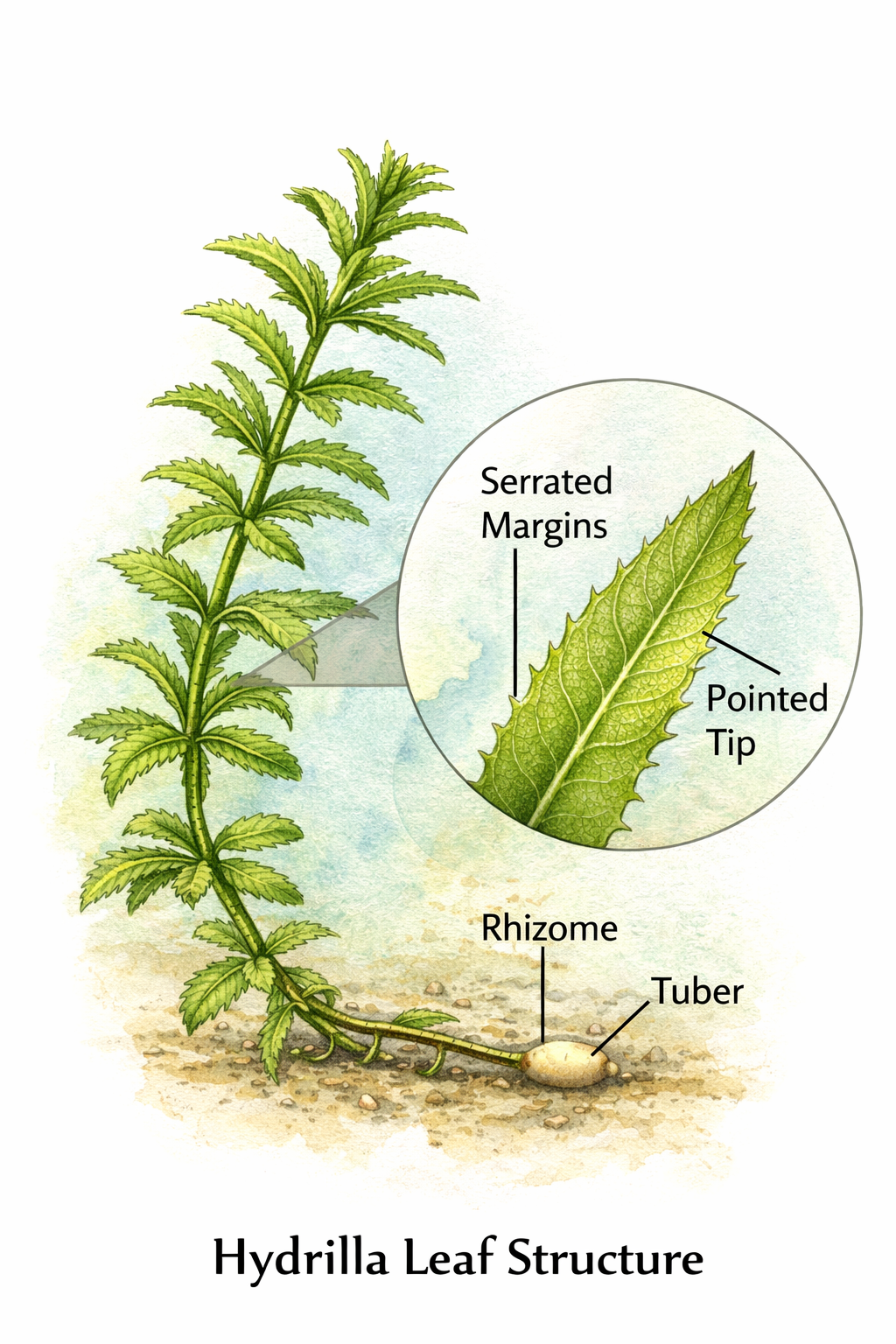
Overview of Leaf Characteristics
Leaf morphology is one of the most reliable methods for identifying Hydrilla verticillata in the field. The species exhibits distinctive whorled leaf arrangement and serrated margins that differentiate it from similar submerged aquatic vegetation.
A full species overview is available in the Hydrilla master guide.
Whorled Leaf Arrangement
Hydrilla leaves grow in whorls around the stem. Each node typically contains 4 to 8 leaves arranged symmetrically.
This whorled structure gives the stem a star-like appearance when viewed from above.
Leaf arrangement differences are detailed in the Hydrilla vs. Elodea comparison.
Leaf Shape and Size
Leaves are narrow, linear to lance-shaped, and generally range from 1 to 2 centimeters in length. The leaf tips may appear slightly pointed.
Leaves are typically bright green and may appear slightly translucent when submerged.
Serrated Leaf Margins
One of the most distinctive identification features of Hydrilla is the presence of small serrations (teeth) along the leaf margins. These teeth are often visible without magnification.
Running a finger gently along the leaf edge may reveal a rough texture caused by these serrations.
Native Elodea species lack prominent serrations, making this a key distinguishing trait.
Midrib Features
The midrib of Hydrilla leaves may contain small spines or projections, particularly on the underside. These are less conspicuous than the margin serrations but can aid confirmation.
Careful inspection under magnification may reveal these structures.
Comparison to Similar Species
Egeria densa typically has 4 to 6 leaves per whorl and lacks pronounced serrations. Its leaves are often broader and more robust.
Detailed comparisons are provided in the Hydrilla vs. Egeria guide.
Field Identification Recommendations
When identifying Hydrilla, examine multiple nodes along the stem. Confirm whorl count, leaf serrations, and midrib characteristics.
Underground structures such as tubers can provide additional confirmation and are described in the tubers section.
Distribution patterns where identification is most critical are documented in the Hydrilla distribution section.
References
Information presented on this page is supported by peer-reviewed research, federal agencies, and state resource management programs.
- U.S. Geological Survey (USGS) – Nonindigenous Aquatic Species Databasehttps://nas.er.usgs.gov
- U.S. Army Corps of Engineers – Aquatic Plant Control Research Programhttps://www.erdc.usace.army.mil
- NOAA Aquatic Invasive Species Programhttps://www.noaa.gov