Hydrilla Life Cycle
Seasonal growth patterns and developmental stages of Hydrilla verticillata, including overwintering structures, vegetative expansion, flowering, and late-season energy allocation.
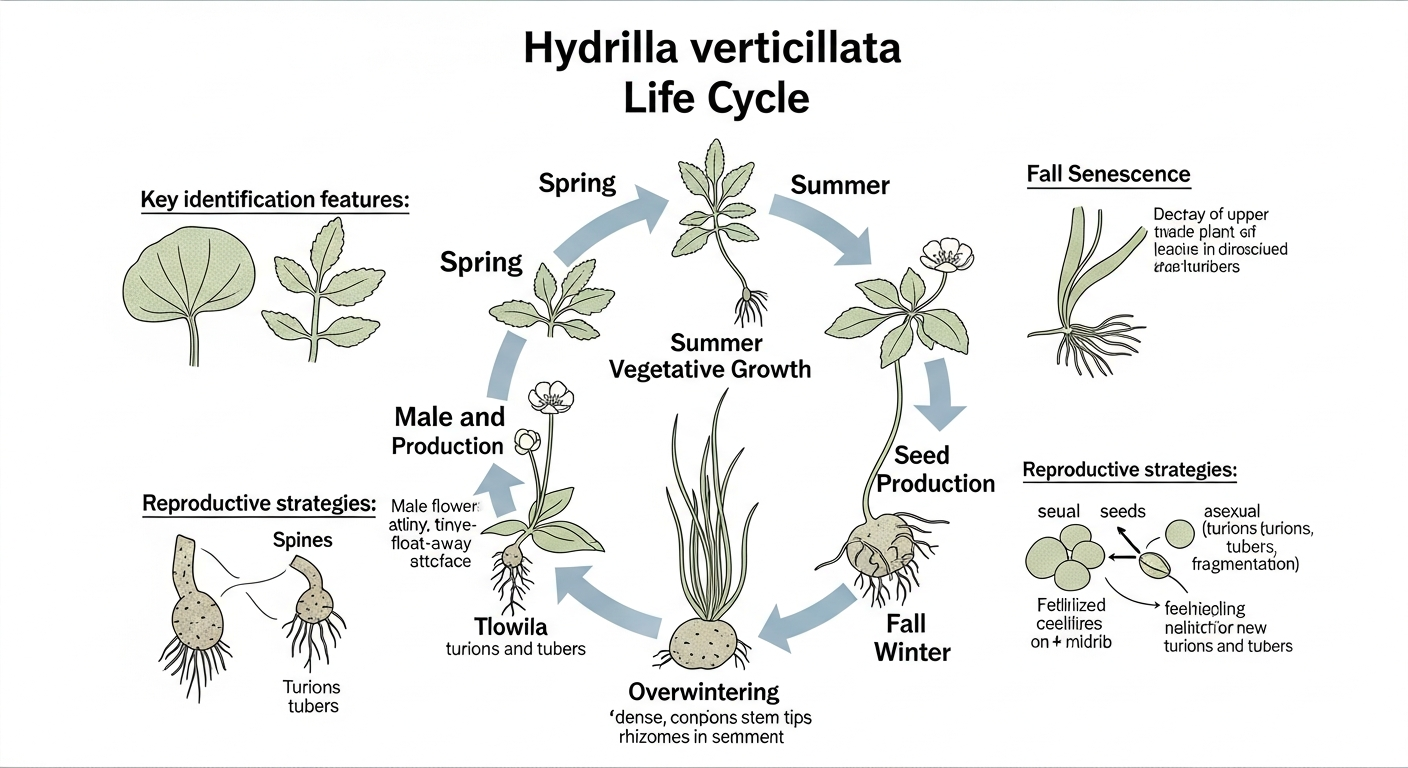
Overview of the Hydrilla Life Cycle
Hydrilla verticillata follows a seasonal growth cycle influenced by temperature, light availability, and nutrient conditions. The species relies heavily on vegetative reproduction and sediment-based survival structures to persist year after year.
A full biological overview is available in the Hydrilla master guide.
Hydrilla Growth Mechanics
Understanding the rapid proliferation and resilient biology of Hydrilla verticillata is critical to managing its spread. Learn more about the specific mechanisms that allow hydrilla to dominate freshwater ecosystems:
Overwintering Phase
In temperate climates, Hydrilla survives unfavorable conditions through subterranean tubers and axillary turions. These structures remain dormant within sediments during colder months.
Tubers are particularly important for long-term persistence and may remain viable for multiple years.
See the detailed discussion of Hydrilla tubers and turions.
Spring Sprouting
As water temperatures rise, dormant tubers and turions begin to sprout. Early growth typically originates from sediment before extending upward through the water column.
Spring sprouting marks the beginning of rapid vegetative expansion.
Rapid Summer Vegetative Expansion
During peak growing season, Hydrilla can grow several centimeters per day under favorable conditions. Stems elongate toward the surface, forming dense canopy layers that intercept light.
Fragmentation during this phase can accelerate spread within a waterbody.
Management during active growth is described in the herbicides section.
Flowering and Sexual Reproduction
Depending on biotype, Hydrilla may produce male and female flowers during the growing season. In monoecious populations, both flower types occur on the same plant.
Sexual reproduction is generally secondary to vegetative propagation in many invaded regions.
Additional detail is available in the reproduction section.
Late-Season Energy Allocation
As daylight shortens and temperatures decline, Hydrilla reallocates energy toward the production of tubers and turions. This stage ensures survival into the next growing season.
Sediment tuber banks formed during this phase often determine the severity of future infestations.
Regional and Biotype Variation
Life cycle timing varies by climate and biotype. Monoecious populations in northern regions may exhibit shorter growing seasons with earlier tuber formation.
Regional distribution patterns are documented in the Hydrilla distribution section.
Implications for Management Timing
Understanding seasonal growth stages is critical for effective management. Herbicide applications are often most effective during active vegetative growth before extensive tuber production.
Integrated management strategies are discussed in the Hydrilla control section.
References
Information presented on this page is supported by peer-reviewed research, federal agencies, and state resource management programs.
- U.S. Geological Survey (USGS) – Nonindigenous Aquatic Species Databasehttps://nas.er.usgs.gov
- U.S. Army Corps of Engineers – Aquatic Plant Control Research Programhttps://www.erdc.usace.army.mil
- NOAA Aquatic Invasive Species Programhttps://www.noaa.gov