Hydrilla (Hydrilla verticillata)
Hydrilla verticillata is a submerged aquatic plant widely recognized for its aggressive growth, persistence, and ecological influence in freshwater ecosystems.
Hydrilla (Hydrilla verticillata) is widely recognized as one of the most aggressive and economically damaging aquatic invasive plants in North America. Since its introduction into Florida waters in the mid-20th century[1], hydrilla has expanded across multiple climatic regions, colonizing freshwater lakes, rivers, reservoirs, canals, and irrigation systems.
Its success as an invader is driven by extraordinary reproductive capacity, physiological adaptability, and resistance to eradication efforts. Hydrilla alters ecosystem structure, interferes with navigation and recreation, disrupts fisheries management, and imposes significant economic costs on municipalities and private landowners.
This guide provides a comprehensive scientific overview of hydrilla, including taxonomy, morphological identification, life cycle, ecological impacts, economic consequences, distribution, and management strategies.
1. Scientific Classification and Taxonomy
Hydrilla verticillata belongs to the family Hydrocharitaceae, which includes several aquatic plant genera found worldwide.
Taxonomic Classification:
- Kingdom: Plantae
- Clade: Angiosperms
- Clade: Monocots
- Order: Alismatales
- Family: Hydrocharitaceae
- Genus: Hydrilla
- Species: Hydrilla verticillata
Unlike many invasive aquatic species, hydrilla is the only species within its genus. This uniqueness makes it taxonomically distinct, though it is frequently confused with morphologically similar species such as Elodea canadensis (American waterweed), Egeria densa (Brazilian waterweed), and Najas spp. (naiads). Correct identification is critical for regulatory and management purposes.
2. Morphological Identification
Hydrilla is a submerged perennial aquatic plant rooted in sediment but capable of forming dense surface canopies.
Stem Structure
- Slender, branching stems
- Can exceed 25 feet in length
- Highly flexible and capable of fragmentation
Leaf Characteristics
- Leaves arranged in whorls of 4–8
- Serrated (toothed) margins
- Visible midrib
- Typically 2–4 inches long
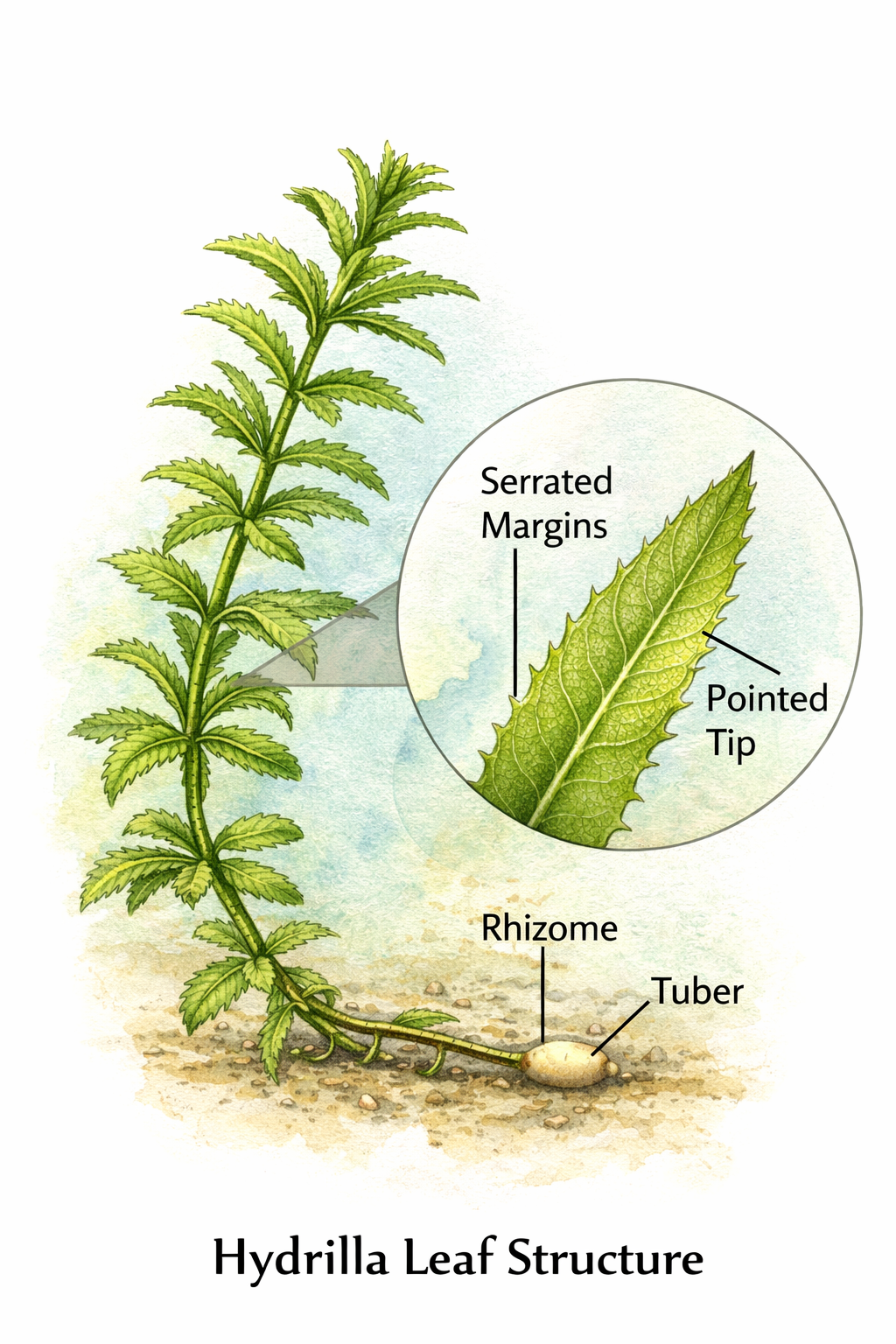
Leaf serrations are a key diagnostic feature. When examined closely, the margins appear toothed, distinguishing hydrilla from many native species.
Roots and Rhizomes
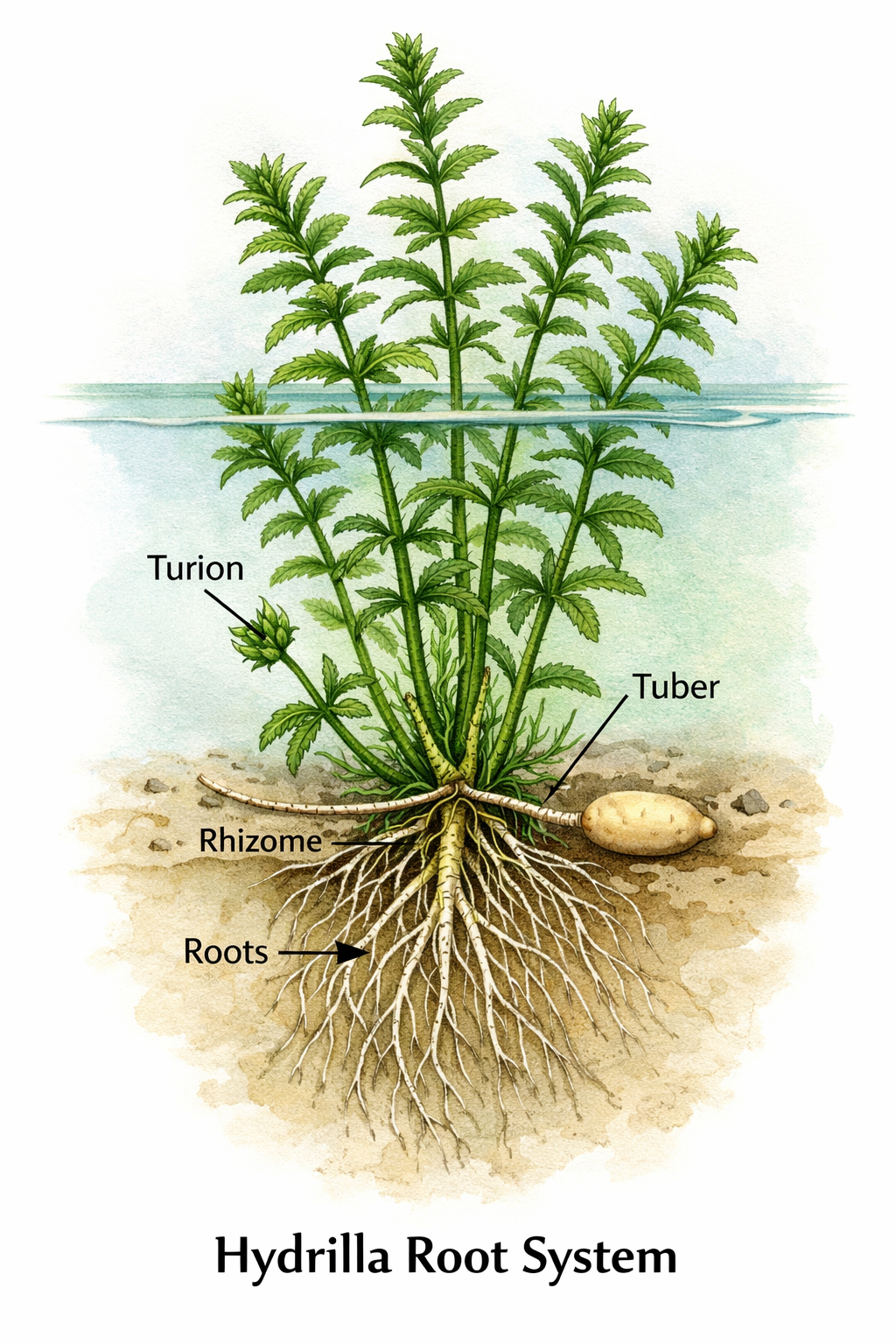
Hydrilla forms fibrous roots, subterranean rhizomes, and tuber-producing structures in sediment. These underground structures are critical to its invasive persistence.
For detailed species comparison, see our identification guide.
3. Native Range and Global Distribution
Hydrilla is native to parts of Asia, Africa, and Australia. It evolved in tropical and subtropical freshwater systems, giving it broad tolerance to variable temperatures, low light conditions, nutrient-rich and nutrient-poor waters, and moderate salinity levels.
Its ecological plasticity contributes significantly to its invasive potential.
4. Introduction to the United States
Hydrilla was introduced to Florida in the 1950s[1], likely through the aquarium trade. It was initially sold as an ornamental aquatic plant before escaping into public waterways.
By the 1960s and 1970s, hydrilla had spread rapidly through Florida’s interconnected canal systems. Subsequent dispersal occurred via recreational boating, waterfowl movement, fragment transport, and flood events.
Today, hydrilla is documented in numerous U.S. states across multiple regions. See our full breakdown of hydrilla distribution.
5. Life Cycle and Reproductive Biology
Hydrilla’s invasive success is primarily due to its complex and redundant reproductive strategies.
5.1 Fragmentation
Hydrilla easily reproduces through fragmentation. Even small stem fragments can drift, root in sediment, and develop into mature plants. Mechanical disturbance often accelerates spread.
5.2 Tubers
Tubers are subterranean storage organs resembling small potatoes. Key characteristics include:
- Produced in sediment
- Can remain viable for 3–10 years[5]
- Resistant to freezing and drought
- Survive herbicide treatment
Tuber banks make eradication extremely difficult.
5.3 Turions
Turions are axillary buds formed along stems. They detach easily, sink to sediment, and germinate under favorable conditions.
5.4 Seeds
Seed production varies by biotype but plays a smaller role in U.S. invasions compared to vegetative reproduction.
6. Monoecious vs Dioecious Biotypes
Two major hydrilla biotypes exist in the United States:
Monoecious
- Both male and female flowers on same plant
- Typically found in northern climates
- Adapted to colder environments
Dioecious
- Male and female flowers on separate plants
- Predominant in southern states
- Often more aggressive in growth
Biotype differences influence management strategy.
7. Ecological Impacts
Hydrilla profoundly alters freshwater ecosystems.
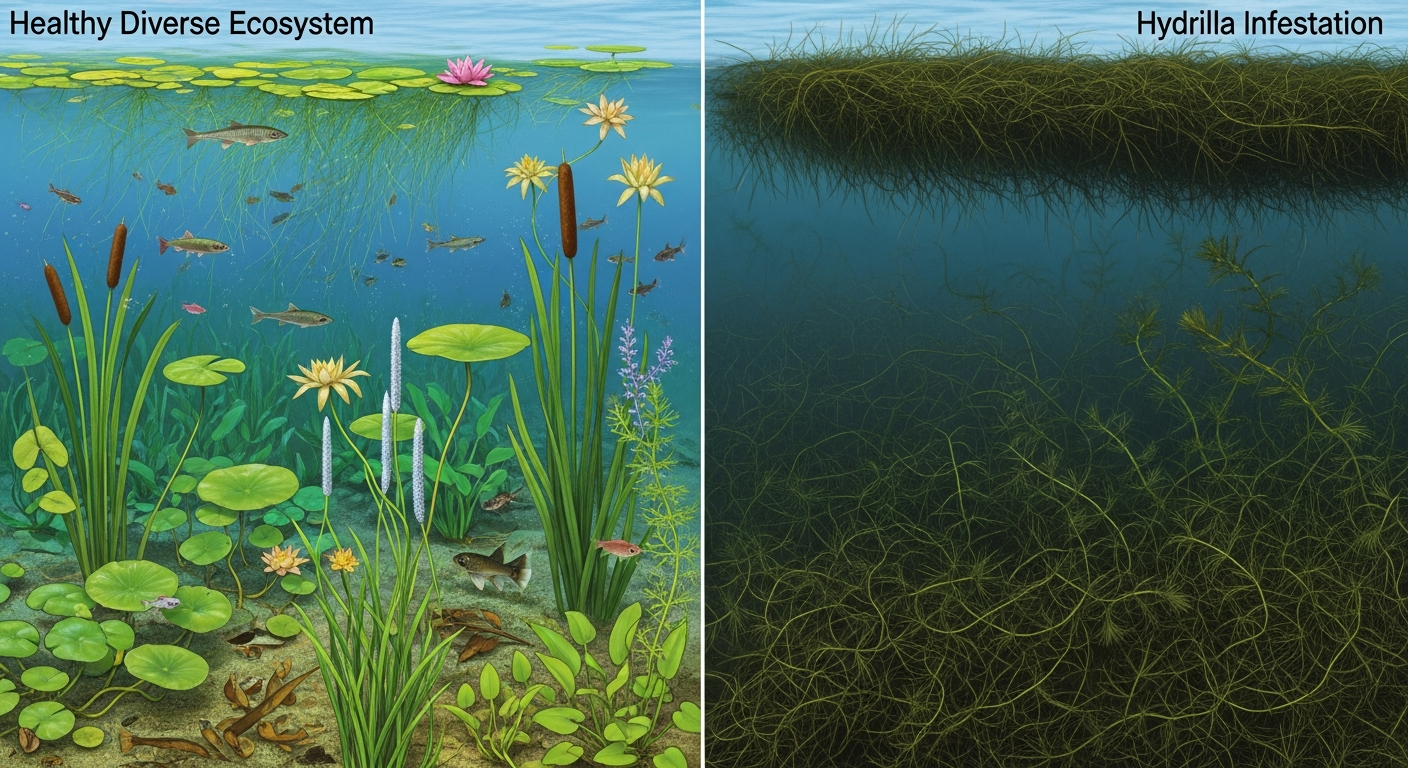
- Light Penetration: Dense canopies block sunlight, reducing growth of native submerged vegetation.
- Dissolved Oxygen: Nighttime respiration in thick mats may reduce oxygen levels, stressing fish populations.
- Habitat Alteration: Hydrilla changes predator-prey relationships, fish spawning habitat, and waterfowl foraging behavior.
- Sediment and Nutrient Cycling: Hydrilla modifies nutrient dynamics, sometimes increasing internal nutrient loading.
See expanded analysis in our ecological impact section.
8. Economic Impact
Hydrilla infestations cause substantial economic costs[2]. Affected sectors include recreational boating, sport fisheries, waterfront property values, hydroelectric facilities, and irrigation infrastructure.
Annual control expenditures in heavily infested states reach tens of millions of dollars. See economic impact details.
9. Avian Vacuolar Myelinopathy (AVM)
Hydrilla can host epiphytic cyanobacteria (Aetokthonos hydrillicola) that produce a neurotoxin associated with Avian Vacuolar Myelinopathy.
AVM has been linked to mortality events involving waterfowl, bald eagles, and other avian predators[4]. The discovery of this toxin added a significant wildlife health dimension to hydrilla management.
10. Regulatory Status
Hydrilla is designated as a Federal Noxious Weed[3] and a prohibited invasive species in many states.
Control efforts are regulated under state aquatic herbicide laws, environmental protection statutes, and water quality regulations. Unauthorized chemical treatment may violate state or federal law.
11. Control and Management
Effective hydrilla management typically requires integrated approaches.
11.1 Chemical Control
Systemic herbicides such as fluridone, ProcellaCOR, and endothall. See detailed comparison: Best Herbicides for Hydrilla.
11.2 Biological Control
Triploid grass carp are used for long-term suppression. See: Grass Carp Cost & Stocking.
11.3 Mechanical Removal
Harvesting reduces canopy but may increase fragmentation. See: Mechanical Removal.
11.4 Integrated Management
Most successful programs combine herbicide treatment, biological control, monitoring, and follow-up treatment. Full overview: Hydrilla Control.
12. Timeline of U.S. Spread (Abbreviated)
- 1950s — Introduction in Florida
- 1960s — Rapid canal system expansion
- 1970s — Spread to southeastern states
- 1980s — Detection in Mid-Atlantic
- 1990s — Expansion into western states
- 2000s–Present — Continued management efforts nationwide
13. Comparison with Similar Species
Hydrilla is frequently confused with Elodea, Egeria, and Naiads. Distinguishing features include tuber production, leaf serration, and whorl density.
Detailed comparison available in the identification section.
14. Long-Term Outlook
Hydrilla is unlikely to be fully eradicated from U.S. waters. Instead, management focuses on suppression, containment, and ecological balance restoration. Adaptive management and monitoring remain critical components of long-term control.
References
- U.S. Geological Survey (USGS). Nonindigenous Aquatic Species Database. https://nas.er.usgs.gov
- U.S. Army Corps of Engineers. Aquatic Plant Control Research Program.
- USDA Invasive Species Compendium: Hydrilla verticillata.
- Wilde, S. et al. (2005). Avian Vacuolar Myelinopathy and Hydrilla-associated cyanobacteria.
- Langeland, K.A. (1996). Hydrilla verticillata Biology and Management.