Hydrilla Root System Identification
Field identification guide to Hydrilla verticillata root structures, including rhizomes, subterranean tubers, and anchoring characteristics.
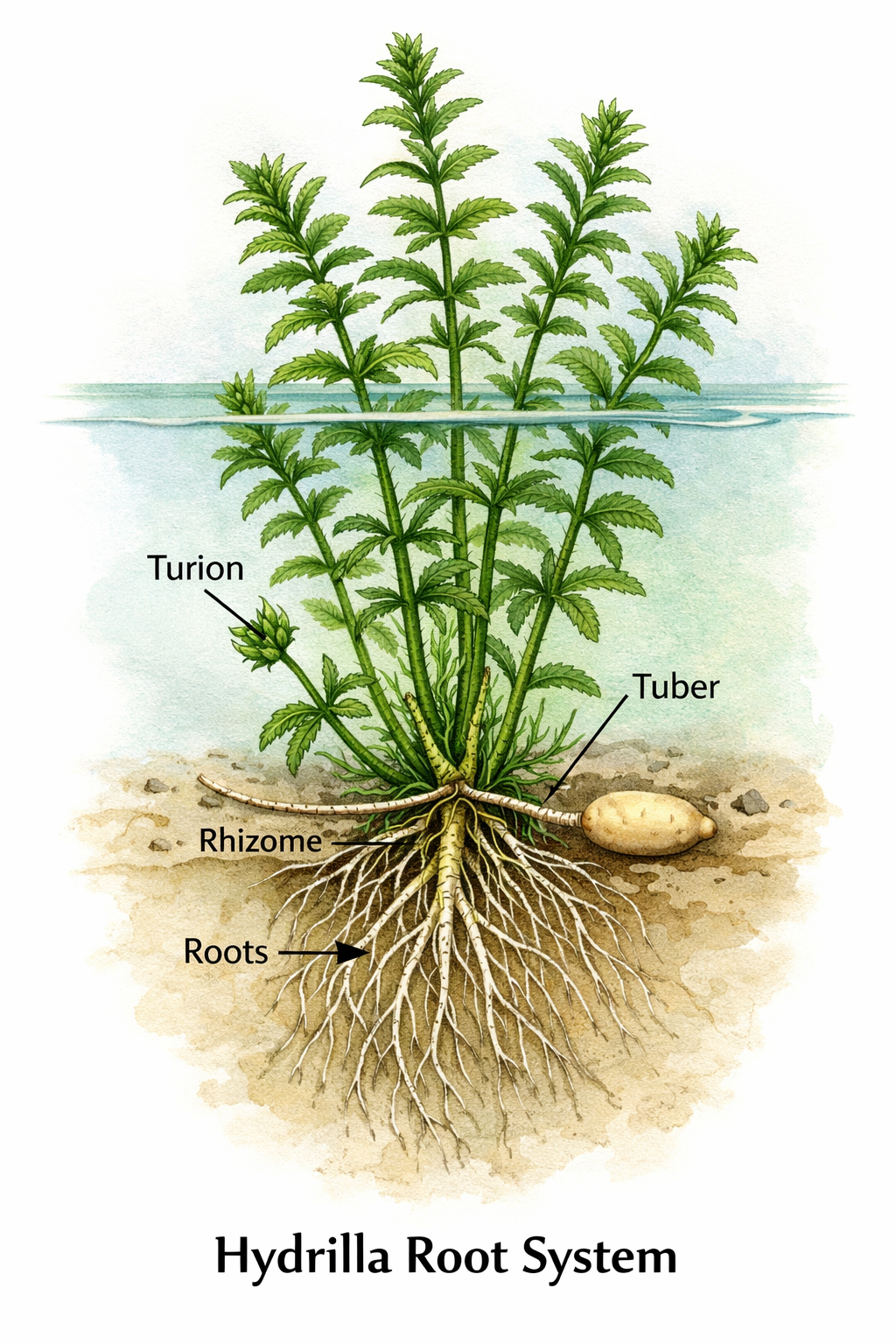
Overview of the Hydrilla Root System
Accurate identification of Hydrilla verticillata often requires examination below the sediment surface. Unlike some similar aquatic plants, Hydrilla produces specialized subterranean structures that contribute to both anchoring and long-term persistence.
A full species overview is available in the Hydrilla master guide.
Roots vs. Rhizomes
Hydrilla possesses true roots that anchor the plant in sediment. However, the most distinctive underground structures are horizontal rhizomes from which tubers develop.
Rhizomes spread laterally beneath the sediment surface and allow the plant to colonize new substrate areas.
Subterranean tubers forming on rhizomes are described in detail in the Hydrilla tubers section.
Tubers as a Diagnostic Feature
One of the most reliable identification markers of Hydrilla is the presence of small, potato-like tubers attached to rhizomes beneath the sediment.
Native Elodea species do not produce subterranean tubers, making this a critical distinguishing characteristic.
Compare identification differences in the Hydrilla vs. Elodea guide.
Anchoring and Sediment Interaction
Hydrilla roots anchor the plant in soft sediment. In shallow systems, dense root and rhizome networks may stabilize sediment and facilitate colony expansion.
The underground network may make complete mechanical removal difficult.
Management implications are discussed in the mechanical removal section.
Comparison to Egeria and Other Look-Alikes
Egeria densa (Brazilian Elodea) may appear similar above water, but it does not produce subterranean tubers. Rooting patterns may also differ in density and rhizome structure.
Detailed comparisons are provided in the Hydrilla vs. Egeria guide.
Field Inspection Recommendations
When confirming Hydrilla presence, gently excavate sediment around plant bases to inspect for rhizomes and tubers. Care should be taken to avoid fragmenting stems during inspection.
Additional identification markers such as leaf serration and whorl arrangement are described in the leaf structure section.
Distribution patterns where field identification is most critical are documented in the Hydrilla distribution section.
References
Information presented on this page is supported by peer-reviewed research, federal agencies, and state resource management programs.
- U.S. Geological Survey (USGS) – Nonindigenous Aquatic Species Databasehttps://nas.er.usgs.gov
- U.S. Army Corps of Engineers – Aquatic Plant Control Research Programhttps://www.erdc.usace.army.mil
- NOAA Aquatic Invasive Species Programhttps://www.noaa.gov