Impact of Hydrilla on Fish Populations
Scientific overview of how Hydrilla verticillata influences fish community structure, predator-prey dynamics, habitat complexity, and long-term fisheries outcomes.
Overview of Fisheries Interactions
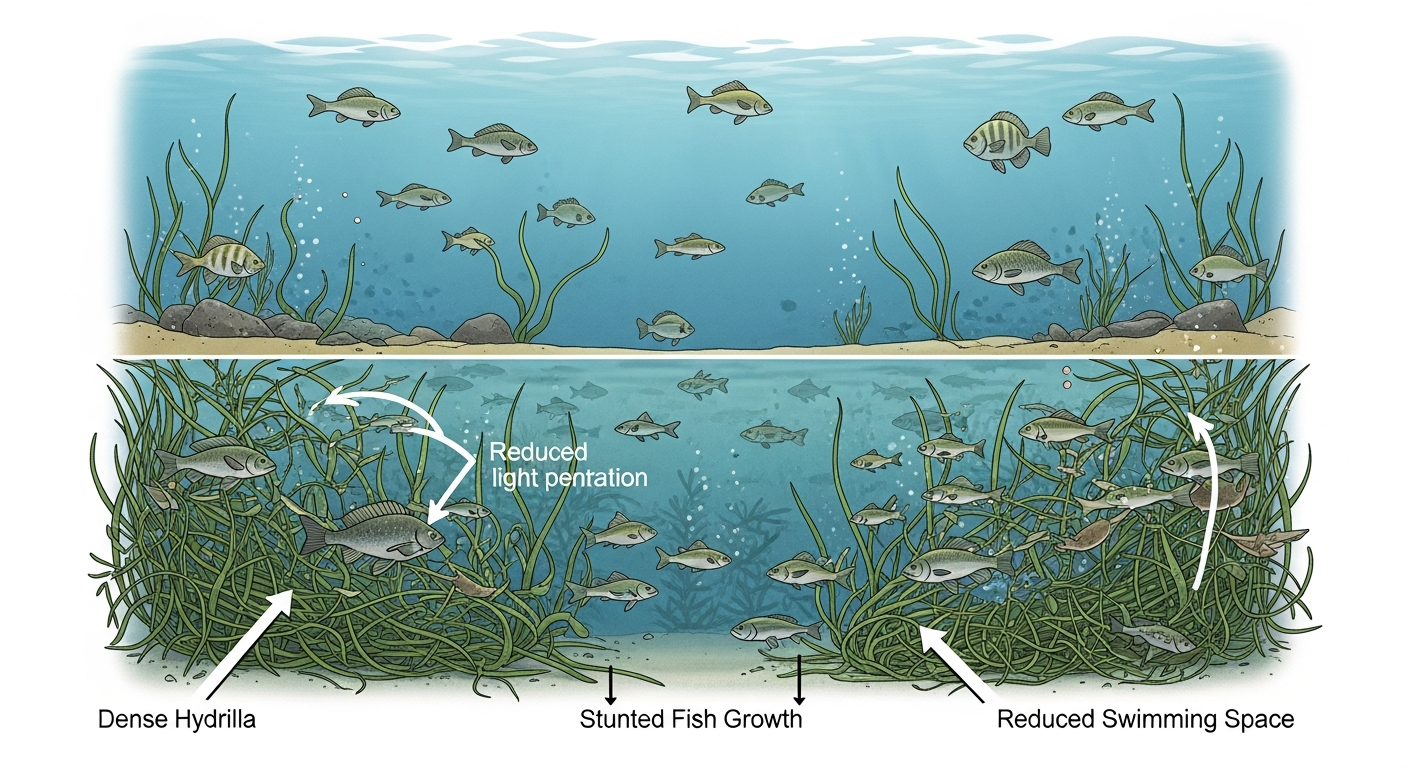
Hydrilla verticillata significantly alters aquatic habitat structure, which in turn influences fish community composition, recruitment success, and predator-prey dynamics.
The relationship between Hydrilla and fisheries is complex. While moderate vegetation can provide beneficial nursery habitat, excessive plant density may negatively affect ecological balance.
A broader overview of Hydrilla’s biology is available in the Hydrilla master guide.
Habitat Complexity and Nursery Effects
Submerged vegetation increases structural complexity within aquatic systems. Young-of-year fish often utilize vegetated areas as refuge from predators.
In moderate densities, Hydrilla may provide protective habitat for juvenile fish species, potentially increasing early survival rates.
However, excessive vegetation density can reduce open-water habitat and alter species balance.
Predator–Prey Dynamics
Dense Hydrilla beds may reduce predator foraging efficiency by limiting visibility and maneuverability. This can shift population structure toward smaller-bodied fish species.
In some reservoirs, anglers report increased bass recruitment associated with moderate vegetation coverage, while others observe stunted growth when plant density becomes excessive.
Distribution patterns affecting regional fisheries are discussed in the Hydrilla distribution section.
Dissolved Oxygen and Water Quality
During daylight hours, photosynthesis in Hydrilla beds may increase dissolved oxygen concentrations. However, nighttime respiration and decomposition of dense biomass can result in oxygen depletion.
Oxygen fluctuations may stress fish populations, particularly in shallow systems with limited circulation.
Broader ecological impacts are described in the ecological impact section.
Spawning Habitat and Recruitment
Some fish species utilize submerged vegetation as spawning substrate. Hydrilla may temporarily increase spawning surface area.
Conversely, dense monocultures may displace native aquatic vegetation that historically supported spawning, potentially altering recruitment patterns.
Biological characteristics that enable Hydrilla to dominate plant communities are detailed in the Hydrilla biology section.
Recreational Fisheries and Angler Perception
Angler perceptions of Hydrilla vary widely. In some systems, moderate vegetation is associated with productive sport fisheries. In others, excessive surface mats reduce navigability and angling access.
Economic consequences of recreational impacts are discussed in the economic impact section.
Implications for Fisheries Management
Fisheries managers often aim to maintain intermediate vegetation coverage that balances habitat complexity with open-water access.
Integrated management strategies combining herbicides, biological control, and monitoring are used to maintain this balance.
Review management approaches in the Hydrilla control section.
References
Information presented on this page is supported by peer-reviewed research, federal agencies, and state resource management programs.
- U.S. Geological Survey (USGS) – Nonindigenous Aquatic Species Databasehttps://nas.er.usgs.gov
- U.S. Army Corps of Engineers – Aquatic Plant Control Research Programhttps://www.erdc.usace.army.mil
- NOAA Aquatic Invasive Species Programhttps://www.noaa.gov