Ecological Impact of Hydrilla
Comprehensive analysis of how Hydrilla verticillata alters aquatic ecosystems, including vegetation displacement, water chemistry changes, habitat modification, and trophic dynamics.
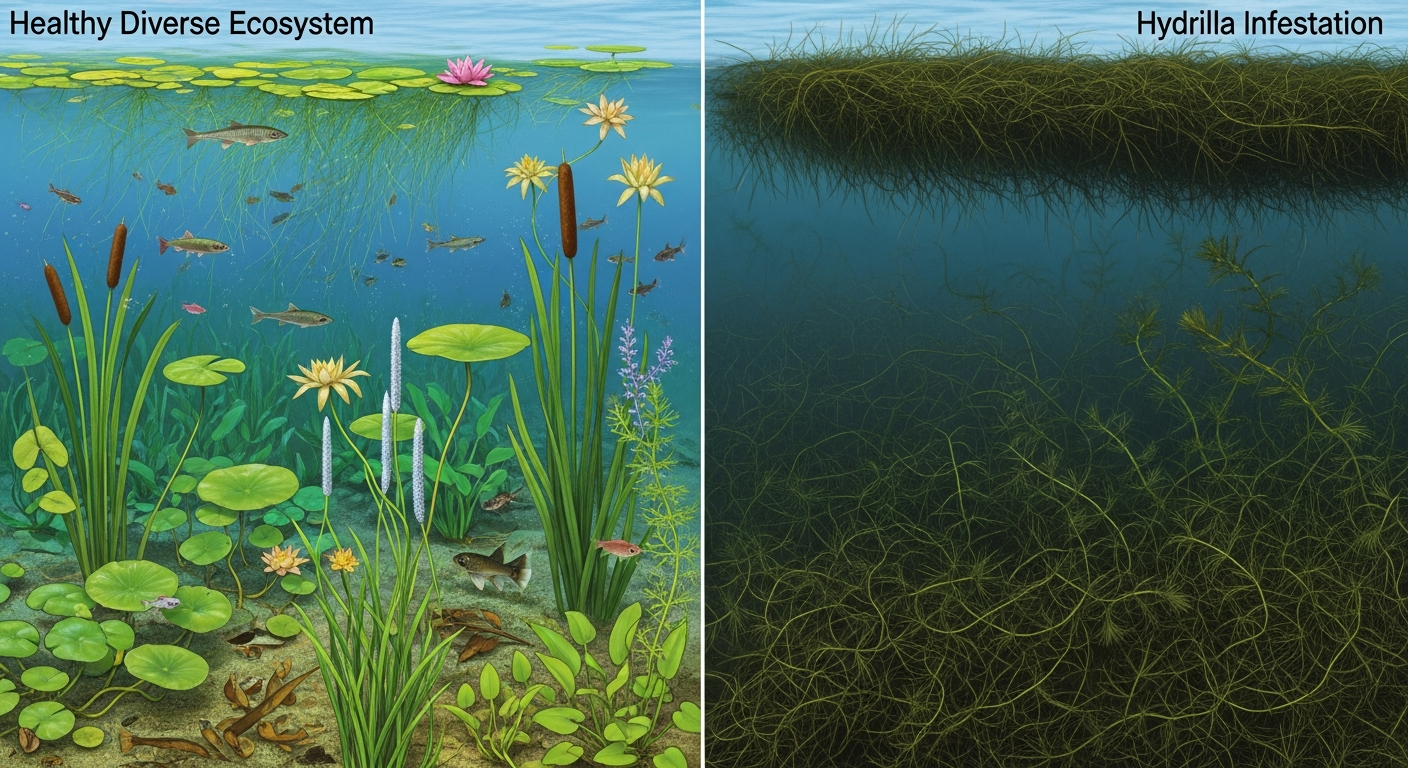
Overview of Ecosystem Alteration
Hydrilla verticillata is capable of fundamentally altering freshwater ecosystems through rapid growth and dense canopy formation. Once established, the species may dominate submerged plant communities and modify physical, chemical, and biological processes within affected water bodies.
Ecological impacts vary by region, climate, nutrient status, and management intensity.
A comprehensive overview of the species is available in the Hydrilla master guide.
Displacement of Native Aquatic Vegetation
Hydrilla often forms dense monocultures that outcompete native submerged aquatic vegetation (SAV). Through rapid vertical growth and canopy formation, the plant reduces light availability to competing species.
Native plants such as eelgrass, pondweeds, and coontail may decline in areas where Hydrilla becomes dominant.
Competitive growth mechanisms are described in the Hydrilla biology section.
Alteration of Light Penetration and Physical Structure
Surface-reaching Hydrilla mats can reduce light penetration into the water column, affecting phytoplankton productivity and benthic communities.
Dense vegetation modifies water flow patterns and increases sediment accumulation in low-energy systems.
Water Chemistry and Oxygen Dynamics
Hydrilla influences dissolved oxygen concentrations through daytime photosynthesis and nighttime respiration. Dense biomass may cause substantial diel oxygen fluctuations.
Decomposition of senescent plant material can increase biological oxygen demand (BOD) and contribute to localized hypoxia.
These changes may stress fish and invertebrate populations, as discussed in the fish populations section.
Nutrient Cycling and Sediment Interaction
Hydrilla absorbs nutrients from both the water column and sediments. Dense infestations may temporarily reduce nutrient concentrations in the water column while storing nutrients within plant biomass.
Upon dieback, nutrient release from decomposing material may contribute to internal nutrient loading.
Effects on Wildlife and Trophic Structure
Changes in vegetation density influence invertebrate communities, fish habitat structure, and waterfowl foraging patterns.
In some systems, Hydrilla may provide forage for certain herbivorous species, while simultaneously altering native plant availability.
In rare cases, Hydrilla has been associated with epiphytic cyanobacteria linked to avian vacuolar myelinopathy (AVM), affecting waterfowl and predatory birds.
Ecological Implications of Management
Control interventions may themselves influence ecological balance. Rapid vegetation removal can expose sediments, alter habitat complexity, and shift trophic dynamics.
Management planning is addressed in the Hydrilla control and management section.
Regional Variation in Ecological Effects
Ecological outcomes vary significantly by geographic region. Climate, nutrient loading, reservoir design, and water flow patterns influence the magnitude of Hydrilla impacts.
Regional distribution patterns are documented in the Hydrilla distribution section.
Economic consequences of ecological disruption are discussed in the economic impact section.
References
Information presented on this page is supported by peer-reviewed research, federal agencies, and state resource management programs.
- U.S. Geological Survey (USGS) – Nonindigenous Aquatic Species Databasehttps://nas.er.usgs.gov
- U.S. Army Corps of Engineers – Aquatic Plant Control Research Programhttps://www.erdc.usace.army.mil
- NOAA Aquatic Invasive Species Programhttps://www.noaa.gov