Hydrilla Turions
Detailed examination of axillary turions in Hydrilla verticillata, including formation, dispersal, seasonal production, and their role in vegetative spread.
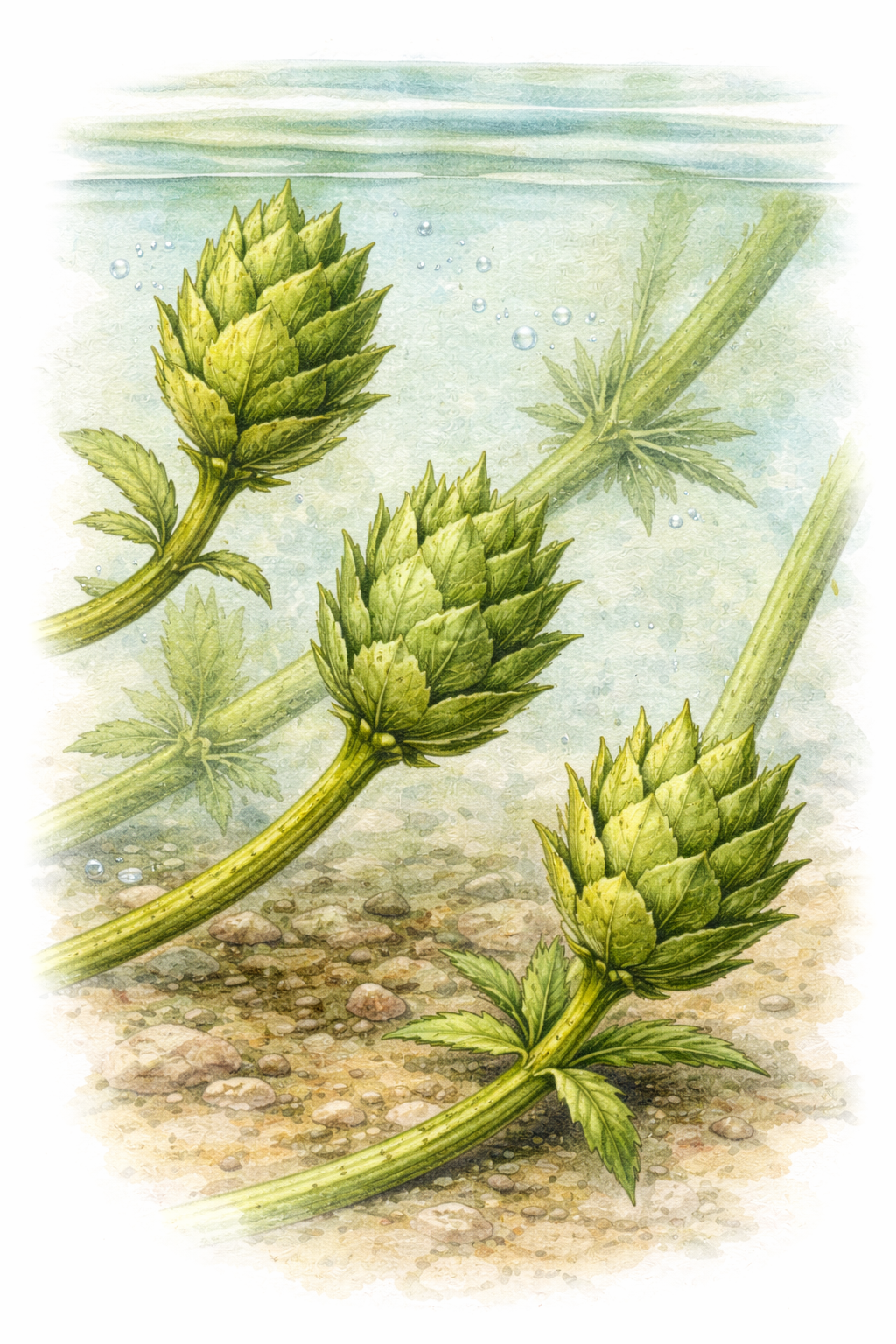
What Are Hydrilla Turions?
Turions are compact vegetative buds that develop in the leaf axils of Hydrilla verticillata. These structures serve as short-term survival and dispersal units.
Unlike subterranean tubers, turions form on above-ground stems and may detach, drift, and establish new plants.
A full overview of Hydrilla biology is available in the Hydrilla master guide.
Turion Formation
Turions develop in the axils where leaves attach to the stem. Environmental conditions such as nutrient availability, temperature, and photoperiod may influence production rates.
Turions are typically denser and more compact than surrounding stem tissue, allowing them to survive detachment and short-term transport.
Broader reproductive strategies are discussed in the reproduction section.
Dispersal Mechanisms
Detached turions may float or drift with currents before settling into suitable substrate. This contributes to localized spread within lakes and reservoirs.
Mechanical disturbance from boating or harvesting can also facilitate dispersal.
Management challenges related to fragmentation and dispersal are outlined in the mechanical removal section.
Seasonal Production
Turion production often increases toward the end of the growing season as environmental conditions begin to change. These structures may overwinter in sediment and sprout in the following season.
Seasonal growth cycles are described in the life cycle section.
Turions vs. Tubers
While both turions and tubers are vegetative reproductive structures, they differ in location and longevity. Tubers form underground and may remain viable for multiple years.
Turions, by contrast, form on stems and generally represent shorter-term survival structures.
Detailed information on tubers is provided in the tubers section.
Implications for Management
Because turions may detach and spread within a waterbody, control efforts must account for regrowth from both sediment-based tubers and floating vegetative material.
Integrated management strategies are discussed in the Hydrilla control section.
Regional spread patterns influenced by vegetative reproduction are documented in the Hydrilla distribution section.
References
Information presented on this page is supported by peer-reviewed research, federal agencies, and state resource management programs.
- U.S. Geological Survey (USGS) – Nonindigenous Aquatic Species Databasehttps://nas.er.usgs.gov
- U.S. Army Corps of Engineers – Aquatic Plant Control Research Programhttps://www.erdc.usace.army.mil
- NOAA Aquatic Invasive Species Programhttps://www.noaa.gov