Reproduction of Hydrilla
Detailed examination of the reproductive strategies of Hydrilla verticillata, including sexual reproduction, vegetative propagation, and biotype variation.
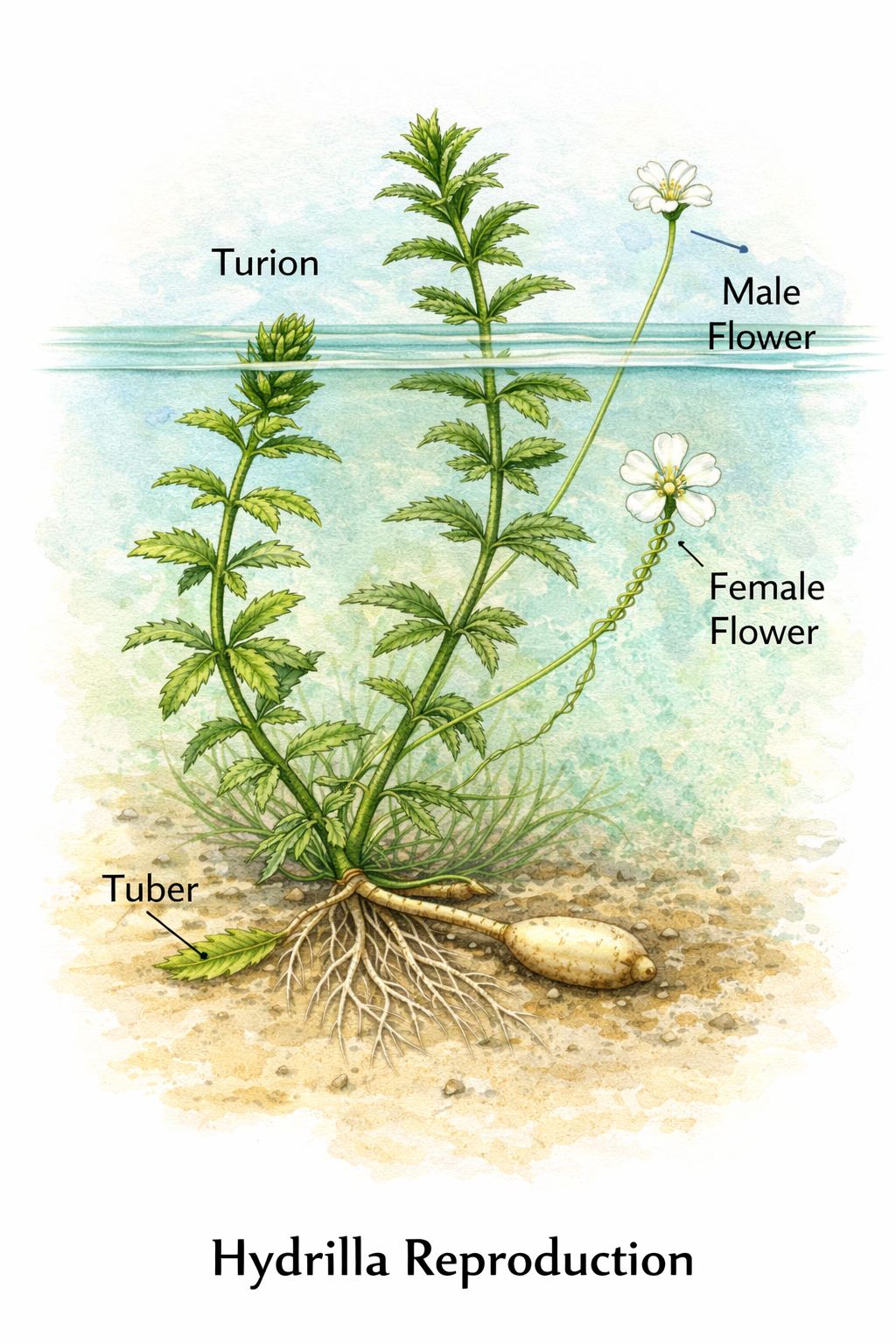
Overview of Reproductive Strategies
Hydrilla verticillata exhibits both sexual and vegetative reproductive strategies. This dual capability contributes significantly to its persistence and spread in freshwater ecosystems.
While vegetative reproduction is typically the dominant mode of expansion in North American populations, sexual reproduction may contribute to genetic variation in certain biotypes.
A broader biological overview is available in the Hydrilla master guide.
Monoecious and Dioecious Biotypes
Hydrilla occurs in both monoecious and dioecious forms. Monoecious plants produce both male and female flowers on the same individual, while dioecious populations consist of separate male and female plants.
In the United States, many early infestations were dioecious, though monoecious biotypes are now widespread and often associated with colder climates.
Biotype differences may influence seasonal growth patterns and management responses.
Sexual Reproduction
Sexual reproduction occurs through the production of small, inconspicuous flowers. Male flowers detach and float to the water surface, where pollination may occur.
Fertilized female flowers produce seeds. However, in many invaded regions, seed production plays a relatively minor role compared to vegetative propagation.
The seasonal timing of reproductive structures is described in the life cycle section.
Vegetative Reproduction and Fragmentation
Vegetative propagation is the primary mechanism of spread in most established infestations. Stem fragments containing a single node are capable of developing into new plants.
Fragmentation may occur naturally through wave action or human activities such as boating and mechanical harvesting.
Management challenges associated with fragmentation are discussed in the mechanical removal section.
Subterranean Tubers
Hydrilla produces subterranean tubers that serve as long-term perennating structures. These tubers can remain viable in sediment for multiple years.
Tuber density in sediments is often a key determinant of management difficulty.
Detailed tuber morphology and longevity are described in the tubers section.
Axillary Turions
Turions are compact vegetative buds formed in leaf axils. These structures may detach and establish new plants.
Turion production varies by environmental conditions and biotype.
Additional detail is available in the turions section.
Geographic Variation in Reproductive Strategy
Reproductive emphasis may vary by region. Monoecious biotypes often dominate in temperate northern climates, while dioecious biotypes are common in southern systems.
Regional spread patterns are outlined in the distribution section.
Implications for Management
The persistence of tubers and the capacity for fragmentation make eradication difficult once populations are established.
Integrated management strategies are typically required to suppress regrowth over multiple growing seasons.
Control approaches are described in the Hydrilla control section.
References
Information presented on this page is supported by peer-reviewed research, federal agencies, and state resource management programs.
- U.S. Geological Survey (USGS) – Nonindigenous Aquatic Species Databasehttps://nas.er.usgs.gov
- U.S. Army Corps of Engineers – Aquatic Plant Control Research Programhttps://www.erdc.usace.army.mil
- NOAA Aquatic Invasive Species Programhttps://www.noaa.gov