Lake Management Strategies for Hydrilla
Strategic planning approaches for long-term Hydrilla verticillata management, including integrated pest management (IPM), monitoring, budgeting, and regulatory coordination.
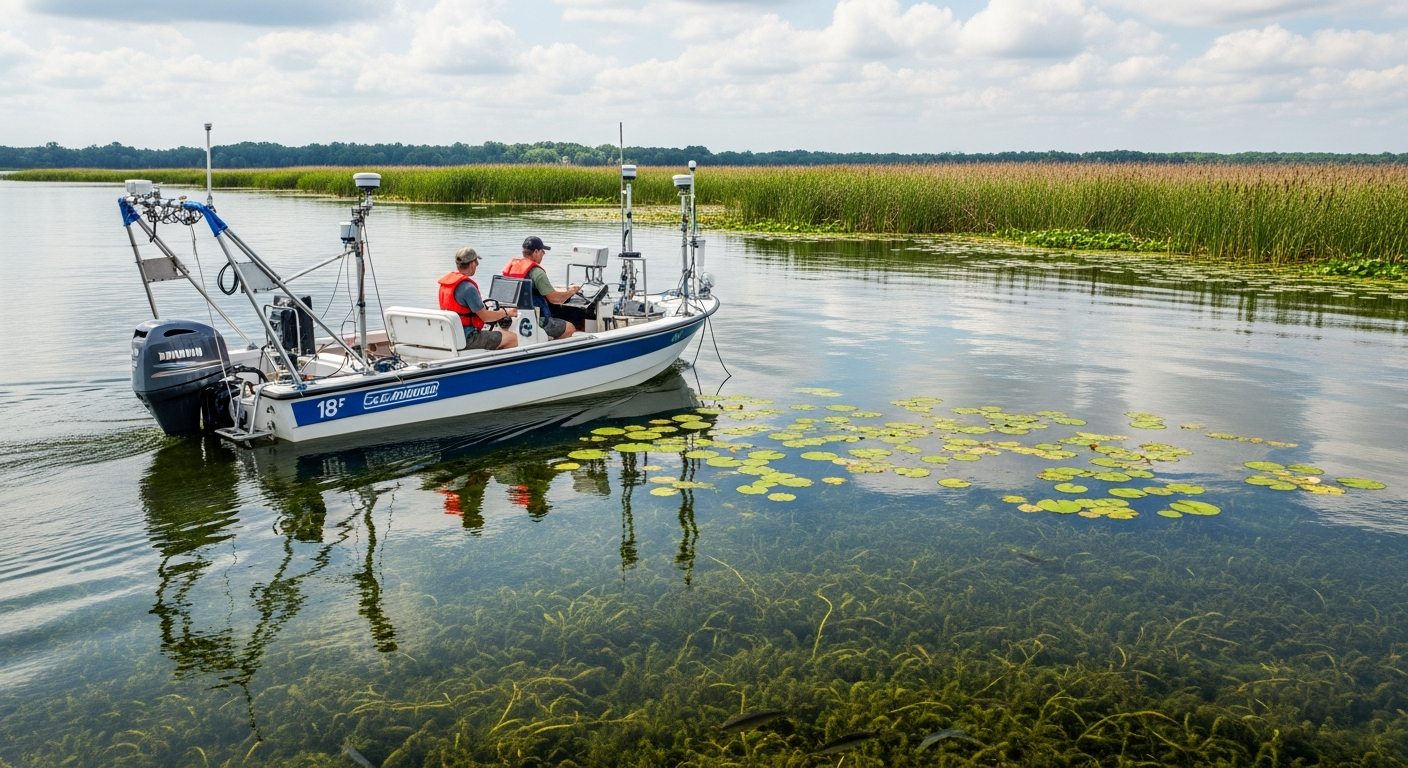
Strategic Overview
Effective Hydrilla verticillata management requires long-term planning rather than isolated treatment events. Lake management programs are typically designed to suppress vegetation growth while maintaining ecological balance, water quality, and recreational access.
Because Hydrilla reproduces through fragmentation, turions, and sediment tubers, eradication is rarely feasible. Instead, management focuses on containment, biomass control, and prevention of secondary spread.
A complete biological overview of Hydrilla is available in the Hydrilla master guide.
Integrated Pest Management (IPM)
Integrated Pest Management (IPM) combines chemical, biological, and mechanical control methods to achieve sustainable suppression of Hydrilla populations.
Rather than relying exclusively on one approach, lake managers evaluate site conditions, infestation density, non-target vegetation, and ecological sensitivity before selecting treatment strategies.
Chemical control options are described in the herbicides section, biological control through triploid grass carp, and physical removal techniques in the mechanical removal section.
Monitoring and Assessment
Ongoing monitoring is critical to adaptive management. Surveys may include aerial mapping, sonar-based biomass assessment, diver sampling, and shoreline inspections.
Monitoring programs track infestation spread, evaluate treatment effectiveness, and detect early-stage regrowth from sediment tubers.
Geographic spread trends are documented in the Hydrilla distribution overview.
Regulatory Compliance and Budgeting
Successful lake management requires navigating complex regulatory frameworks, including environmental impact statements and discharge permits. Long-term budgeting must account for recurring treatments, as Hydrilla control is typically an ongoing maintenance expense rather than a one-time cost.
Economic implications of management programs are further explored in the economic impact section.
References
Information presented on this page is supported by peer-reviewed research, federal agencies, and state resource management programs.
- U.S. Geological Survey (USGS) – Nonindigenous Aquatic Species Databasehttps://nas.er.usgs.gov
- U.S. Army Corps of Engineers – Aquatic Plant Control Research Programhttps://www.erdc.usace.army.mil
- NOAA Aquatic Invasive Species Programhttps://www.noaa.gov